
SlideServe
Menu
Préférences
© SlideServe · v2026

Enhancing Data Attribution and Citation in Life Sciences: Challenges and Innovations

petra-knox avatar
12 diapositives · 247 Views · Nov 05, 2014

This presentation by Philip E. Bourne at UCSD discusses the importance of data attribution and citation in the life sciences community. It highlights the discrepancies in data citation practices across different data repositories, emphasizing the need for standardized approaches such as DOIs. The presentation uses the Protein Data Bank (PDB) as a case study, showcasing its extensive user base, challenges in data management, and the potential lifesaving impact of structured data. The integration of literature and databases is crucial for advancing research and fostering collaboration.
Enhancing Data Attribution and Citation in Life Sciences: Challenges and Innovations - slide 1
01 / 12Enhancing Data Attribution and Citation in Life Sciences: Challenges and Innovations
1 / 17

Télécharger la présentation

Enhancing Data Attribution and Citation in Life Sciences: Challenges and Innovations
Une image / un lien ci-dessous est fourni (tel quel) pour télécharger la présentation

Politique de téléchargement : le contenu du site vous est fourni TEL QUEL pour votre information et votre usage personnel ; il ne peut être vendu, concédé sous licence ni partagé sur d’autres sites sans l’accord de son auteur.Le contenu vous est fourni TEL QUEL, pour votre information et votre usage personnel uniquement. Téléchargez la présentation en cliquant sur ce lien. Lors du téléchargement, si vous ne parvenez pas à télécharger une présentation, l’éditeur a peut-être supprimé le fichier de son serveur.Pendant le téléchargement, si vous ne parvenez pas à obtenir une présentation, le fichier a peut-être été supprimé par l’éditeur.

F I N

Plus de contenu associé

Transcription de la présentation
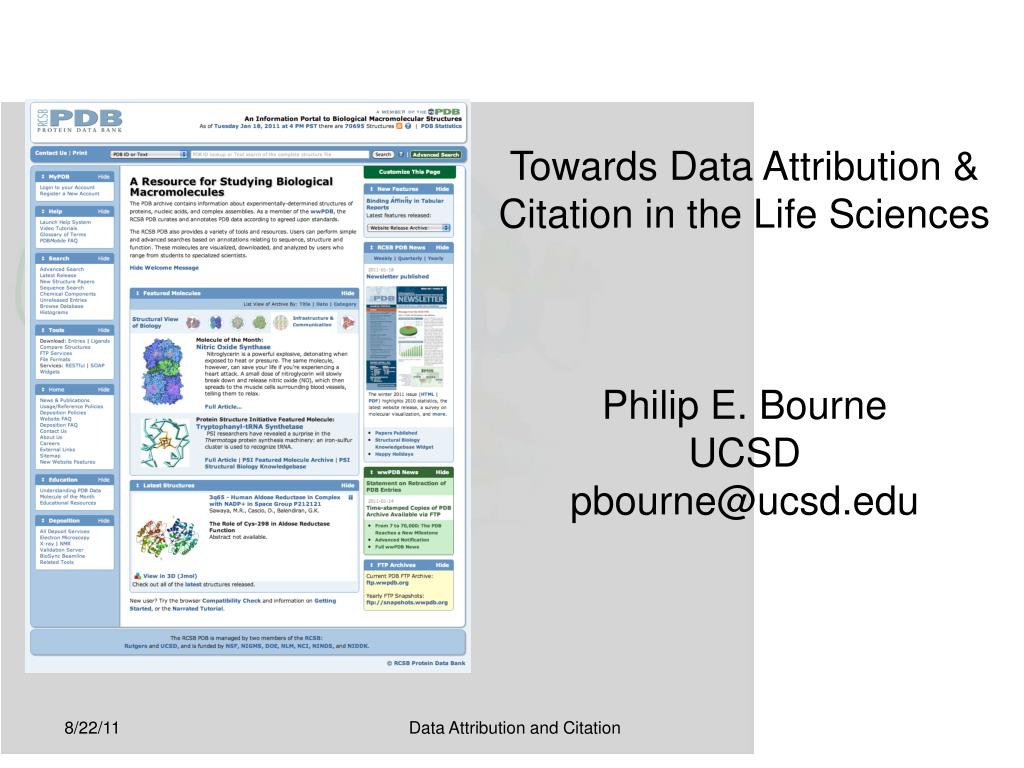
  1. Towards Data Attribution & Citation in the Life Sciences Philip E. Bourne UCSD pbourne@ucsd.edu Data Attribution and Citation

  2. Life Science Data Repositories • NLM is the elephant in the room .. However .. • There are thousands on community maintained efforts – all want an NAR publication • The ability to cite and attribute the data are highly variable: • DOIs assigned in some cases, but not used • Attribution is through the metadata in most cases • Citation is typically by the associated literature reference if it exists, and/or a database identifier • The use of data repositories such as Dryad is compelling for the long tail problem • Data journals are on the horizon Data Attribution and Citation

  3. Consider the PDB as a Use Case • Oldest data resource in biology? • A resource used by ~ 200,000 individuals per month – increasing number of school kids! • A resource distributing worldwide the equivalent to ¼ the National Library of Congress each month • A bicoastal/worldwide resource • 1TB Data Attribution and Citation

  4. PDB Typical Growth Curve – But the Complexity! Number of released entries Year

  5. Number of visits and page views is growing faster than number of unique visitors People are doing more with the data

  6. The Data May Save Lives? * Structure Summary page activity for H1N1 Influenza related structures Jan. 2008 Jul. 2008 Jan. 2009 Jul. 2009 Jan. 2010 Jul. 2010 3B7E: Neuraminidase of A/Brevig Mission/1/1918 H1N1 strain in complex with zanamivir 1RUZ: 1918 H1 Hemagglutinin * http://www.cdc.gov/h1n1flu/estimates/April_March_13.htm

  7. PDB Data Attribution and Citation • About 25% of our budget has been spent on data remediation – multiple versions supported – the copy of record (as defined by the publication) is always available • Cant publish unless data are deposited – motivated by the community - very good data to publication correspondence • Data objects are discreet and we assign DOIs – but they are not used – database identifiers preferred Data Attribution and Citation

  8. Ah yes .. But the CD4 Story…

  9. Literature/Data Integration User clicks on content Metadata and webservices to data provide an interactiveview that can be annotated Selecting features provides a data/knowledge mashup Analysis leads to new content I can share The Knowledge and Data Cycle 0. Full text of PLoS papers stored in a database 4. The composite view has links to pertinent blocks of literature text and back to the PDB 4. 1. 3. A composite view of journal and database content results 1. A link brings up figures from the paper 3. 2. 2. Clicking the paper figure retrieves data from the PDB which is analyzed PLoS Comp. Biol. 2005 1(3) e34

  10. Example of Interoperability: The Database View www.rcsb.org/pdb/explore/literature.do?structureId=1TIM BMC Bioinformatics 2010 11:220

  11. Example of Interoperability – The Literature View From Anita de Waard, Elsevier

  12. Acknowledgements Funding Agencies: NSF, NIGMS, DOE, NLM, NCI, NCRR, NIBIB, NINDS, NIDDK Data Attribution and Citation 12