Ancient Greece
Explore the world of Ancient Greece in the 4th century B.C., a time when it was a superpower revered for its rich culture and worship of gods like Zeus and Apollo. Central to this era was playwright Sophocles, known for his celebrated work "Oedipus Rex". Performed during the Festival of Dionysus, this tragedy explores themes of fate, truth, and human pride against a backdrop of male actors and a chorus. Discover how the riddle of the Sphinx propels Oedipus on a fateful journey filled with dramatic irony and profound insights into the human condition.

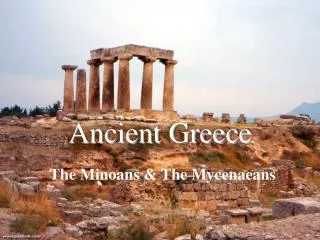
Ancient Greece
E N D
Presentation Transcript
Ancient Greece Sophocles and Oedipus Rex
Greece in the 4th Century B.C • Greece was the superpower of the known world • The Greeks worshiped many gods: Zeus, Hera, Athena, Apollo, etc. • Greek citizens were required to attend festivals to worship and honor the gods.
Festival of Dionysus • God of wine, agriculture, and theater • During this religious festival there was a theater competition – each competing playwright submitted 3 tragedies and 1 comedy • Winners won a goat • The most successful and recognized playwright was Sophocles
Sophocles • Wrestler, musician, general, politician • Very handsome and successful • Celebrated playwright • 120 (ish) plays • 20 (ish) first prizes • Only 7 plays remain – the most famous: Oedipus Rex
Theater of the Greeks • Every show was performed during the day • Audiences could be as many as 14,000 • Minimal, if any set, usually just a door • Only male actors, who all wore masks
The Chorus • Group of around 15 men, speaking with one voice as one character • 3 jobs: summarize, pray, speak for the people
Oedipus Rex Notes… • Remember: • This is a story that was not invented by Sophocles • The original audiences would have known the story and how it ended
What Happened Before… • Oedipus leaves his home city of Corinth to go wandering – some prophecy scarred him • Comes to a crossroad and kills a small group of people who wouldn’t get out of his way • Arrives at the city of Thebes who has recently lost their king • Thebes is under siege of the Sphinx and her riddle • Oedipus answers riddle, Sphinx dies, Oedipus is made king and marries the previous queen
Sphinx’s Riddle…how smart are you? • What walks on four legs in the morning, two in the afternoon, and three in the evening? • Answers? (you die if you get it wrong…) • A man – child, healthy adult, old man with a cane
Another Greek god to Know: Apollo… • Greek god of music, medicine, light, sun, truth, knowledge, and poetry • Had an oracle at Delphi: the most famous oracle of Ancient Greece • What’s an oracle?
Oedipus Rex Notes… • Themes • Willingness to ignore the truth • Limits of free will • Human pride • Symbolism • Sight and Light = Truth • Blindness and Dark = Ignorance/lies • Motifs • Sight vs. Blindness / Light vs. Dark
Literary Terms for you… • Irony – when the opposite of what is expected happens • Situational Irony – when a character or reader expects one thing to happen but something else entirely happens • Verbal Irony – when someone says one thing but means another • Dramatic Irony – the contrast between what a character knows and what the reader or audience knows