Understanding Enzymes: Catalysts in Biological Reactions
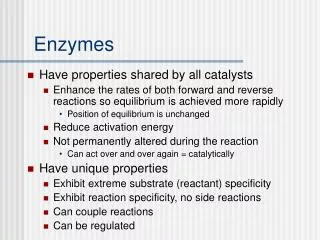
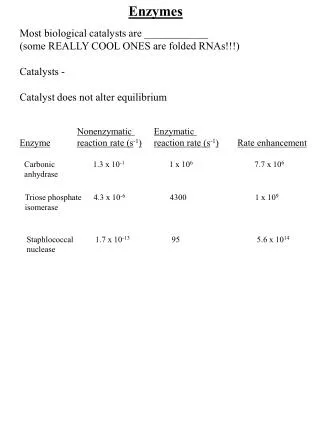
Enzymes are proteins that act as catalysts, speeding up biochemical reactions by lowering the energy required to initiate them. They remain unchanged during reactions and work at specific active sites that fit reactants like a lock and key. Factors affecting enzyme activity include environmental conditions (temperature, pH), cofactors (inorganic substances), and enzyme inhibitors (competitive and noncompetitive). Lysosomes, containing digestive enzymes, break down waste within cells, playing a crucial role in cellular recycling and the endomembrane system.

Understanding Enzymes: Catalysts in Biological Reactions
E N D
Presentation Transcript
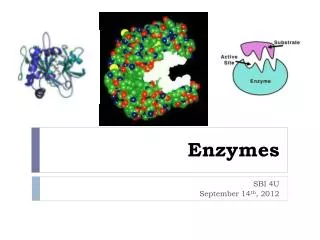
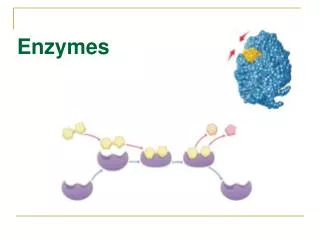
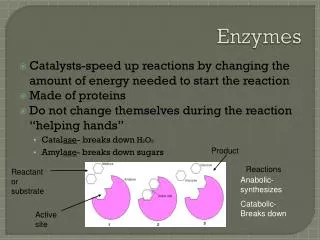
Enzymes • Catalysts-speed up reactions by changing the amount of energy needed to start the reaction • Made of proteins • Do not change themselves during the reaction “helping hands” • Catalase- breaks down H2O2 • Amylase- breaks down sugars Product Reactions Reactant or substrate Anabolic- synthesizes Catabolic-Breaksdown Active site
A enzyme & substrate fit like a lock & key (shape specific) and like a hand in a glove – “induced fit” Active site is where the reactants bind to the enzyme
What Affects Enzyme Activity? • Three factors: 1. Environmental Conditions 2. Cofactors and Coenzymes 3. Enzyme Inhibitors
Environmental Conditions 1. Extreme Temperature are the most dangerous - high tempsmay denature (unfold) the enzyme. 2. pH (most like 6 - 8 pH near neutral) 3. Ionic concentration (salt ions)
2. Cofactors and Coenzymes • Inorganic substances (zinc, iron)andvitamins (respectively) are sometimes needed for proper enzymatic activity. • Example: Iron must be present in the quaternary structure-hemoglobin in order for it to pick up oxygen.
Enzyme Competitive inhibitor Inhibitors Competitive inhibitors: are chemicals that resemble an enzyme’s normal substrate and compete with it for the active site. Substrate
Noncompetitive inhibitors: Inhibitors that do not enter the active site, but bind to another part of the enzyme causing the enzyme to change its shape, which in turn alters the active site. Noncompetitive Inhibitor Enzyme active site altered Inhibitors Substrate
This is a graph of an enzyme reaction. If the conditions are favorable, and there is enzyme and substrate available, the enzymatic reaction will reach its optimal efficiency where the speed of product production can get no faster. If conditions change (such as pH goes outside of enzyme range, temperature goes outside of enzyme range, or concentration of product, enzyme, or substrate changes) the amount of product produced will decrease or stop completely.
Lysosomes • organelles containing enzymes that digest worn out organelles, bacteria, or viruses • when a cell dies its lysosomes burst and break down the cell into macromolecules that are reused by other cells • are part of the Endomembrane system. • The Endoplasmic Reticulum (synthesis and transport) connects with the Golgi Apparatus (molecule packaging) which makes the lysosomes