Understanding the Evolution of Seedless Plants and Their Adaptations
This article delves into the fascinating evolution of seedless plants, exploring their journey from nonvascular forms in the Ordovician period to advanced vascular species in the Devonian and beyond. It covers key adaptations to terrestrial life, including the development of apical meristems, multicellular embryos, and spore production. We examine the classification of nonvascular (Bryophyta, Hepatophyta, Anthocerophyta) and vascular seedless plants (Lycophyta, Psilophyta, Sphenophyta, Pterophyta), and their unique reproductive strategies, highlighting the intricate relationships between plant evolution and their environment.

Understanding the Evolution of Seedless Plants and Their Adaptations
E N D
Presentation Transcript
Plant Evolution • Nonvascular Seedless plants • (Ordovician - 475 mya) • Vascular Seedless plants • (Devonian - 400 mya) • Vascular Seed plants • (Carboniferous - 360 mya) • Flowering plants • (Cretaceous - 130 mya)
Plant Evolution(Common with Algae) • Multicellular and Eukaryotic • Cell walls made of Cellulose • Chlorophyll a and b • Store excess sugar as starch
Charophyceans • Homologous Cell Walls • Peroxisome enzyme (Photorespiration) • Homologous Chloroplasts • Sperm ultrastructure • Phragmoplasts (Mitosis & Cytokinesis) • Genetic Relationships
Adaptations to Terrestrial Life • Apical Meristems • Multicellular Dependent Embryos • Alternation of Generation • Walled Spores produced in Sporangia • Other Adaptations • Cuticle, stomata, Xylem & Phloem, secondary compounds
Adaptations in Shallow Water Algae • Subjected to occasional drying • Protection of gametes and embryos in gametangia • Sporopollenin
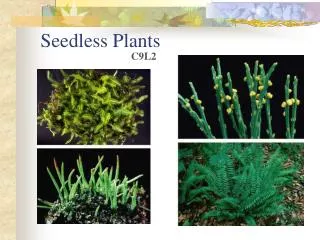
Nonvascular Seedless plants Bryophyta Mosses Hepatophyta Liverworts Anthocerophyta Hornworts Vascular Seedless plants Lycophyta Club mosses Psilophyta Whiskferns Spenophyta Horsetails Pterophyta Ferns Classification of Seedless Plants
Nonvascular Seedless Plants • Plant is a thallus (no vascular tissue) • no true leaves, roots, stems • Embryophytes • gametangia • (antheridium and archegonium) • sporangium (produces spores)
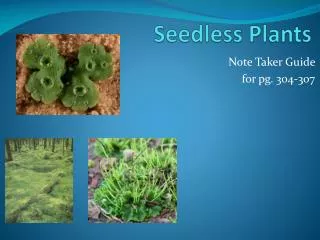
Hepatophyta • Liverworts • Two forms • leafy (80%) • thalloid (20%)
Hepatophyta • Liverworts • Reproduction • asexual (gemmae cups) • sexual
Anthocerophyta • Hornworts • Similar to liverworts except for sporophytes • Most closely related to higher plants
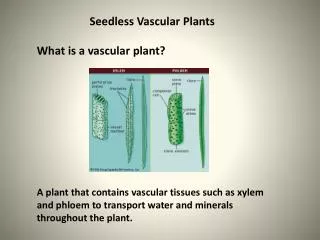
Vascular Seedless Plants • Formation of vascular tissue • Xylem (water) • Phloem (food) • True leaves, roots, and stems • Lignin • Sporophyte generation dominate • Sperm with flagella
Lycophyta • Lycophytes • true leaves • microphylls • true stems • true roots • sporophylls • leaves that produce spores
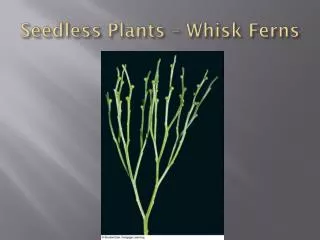
Psilophyta • Whisk Ferns • no true leaves • no true roots
Sphenophyta • Horsetails • true leaves • microphylls • true stems • silica • true roots