Exploring the Rich History and Culture of the Fertile Crescent and Ancient Civilizations
Delve into the fascinating history of the Fertile Crescent, covering the ancient civilizations of Mesopotamia, Babylonia, Assyria, Hebrews, Phoenicians, and Lydians. This region, known for its fertile soil and rich agricultural development, played a crucial role in the rise of organized societies. Discover key concepts including city-states, polytheism, and the significance of irrigation systems. Learn about influential figures like Moses and Sargon, and the development of important texts such as the Torah and the Code of Hammurabi. Uncover the interconnections between these civilizations that shaped human history.

Exploring the Rich History and Culture of the Fertile Crescent and Ancient Civilizations
E N D
Presentation Transcript
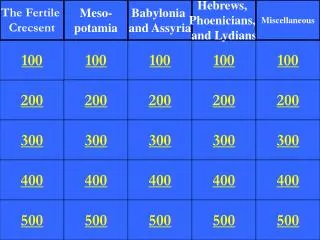
The Fertile Crecsent Meso- potamia Babylonia and Assyria Hebrews, Phoenicians, and Lydians Miscellaneous 100 100 100 100 100 200 200 200 200 200 300 300 300 300 300 400 400 400 400 400 500 500 500 500 500
Groups of people who have a complex and organized society within a culture.
All or part of the countries of Iran, Iraq, Jordan, Syria, Lebanon, Israel, Kuwait, and Saudi Arabia.
The trenches or ditches that brought water from rivers to their fields for watering crops.
A city that is an individual unit, complete with its own form of government and traditions.
A pyramid-shaped temple complex that Mesopotamians believed linked the heavens to Earth.
This was what a person who could read or write was called, also known as a professional writer.
A large territory – consisting of many different places – all under the control of a single ruler.
This crowned king of Babylon took over much of Assyrian Empire and the desert land west of Babylon.
This was a new concept for this time – the belief in one God..
One of the first monotheistic religions with Abraham being viewed as its founder..
This man was chosen by God to lead the Hebrews out of Egypt, across the Sinai desert to freedom, and to receive the Ten Commandments on Mt. Sinai.
This is the exchange of goods or services for other goods or services – no money was used..
This was a mythical figure thought to be 2/3 god and 1/3 human. The epic of this hero contain many human experiences such as friendship, happiness, love, and the search for everlasting life.
This Akkadian was abandoned as a baby – having been placed in a basket in the river. He was rescued by a gardener and worked as a servant to the ruler of Kish. He quickly rose through the ranks, and gave himself the name Sharru-kin which means “Rightful King”.
This man was a brilliant, but brutal warrior. He repeatedly dammed rivers to cut off the supply of water to a city-state, and later would flood the city to weaken it so he could take control.