Important Field Trip on Tectonics This Saturday - Details Inside!
Reminder for all students: This Saturday's field trip to Cottonwood Canyon is important! We'll meet at the GS loading dock at 7:45 AM. Please bring your hiking gear, lunch, and plenty of water. Remember, you can earn extra credit by attending a Geoscience colloquium related to tectonics and submitting a summary of the main points discussed. We will explore topics like normal faults, rifting, and continental margins. Don't miss this opportunity to enhance your understanding of geological processes!

Important Field Trip on Tectonics This Saturday - Details Inside!
E N D
Presentation Transcript
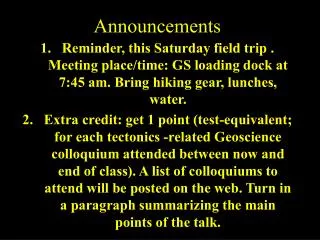
Announcements Reminder, this Saturday field trip . Meeting place/time: GS loading dock at 7:45 am. Bring hiking gear, lunches, water. Extra credit: get 1 point (test-equivalent; for each tectonics -related Geoscience colloquium attended between now and end of class). A list of colloquiums to attend will be posted on the web. Turn in a paragraph summarizing the main points of the talk.
Normal faults -rifted continental margins -form in extension -typical for continental and oceanic lithosphere -jargon (horsts, grabens, listric, detachment) -are they low-angle? -core complexes -Example: Basin and Range, -the way we think it works, mechanically - Normal fault systems(D&R: 340-357)
It’s low angle, but so are thrust faults: KEY: puts young (hanging wall) on old (footwall). The fault markers (slickenlines Etc) are the same.
Horsts and grabens Iin agreement with Coulombian mechanics
Some problems with the model- Most faults look listric and low angle Listric
Simple shear A complication of simple shear
Sedimentation takes place during faulting; Also block rotation domino-style
Figuring out timing of extension: 1. Magmatism 2. Sedimentation
High angle faults are present too- East African rift large scale example Moab fault
Basin and Range- world’s most studied extensional province-low-angle normal faulting prevails.
Exhumation of metamorphic cores beneath detachment faults Extension of the upper crust commonly requires flow in the mid- to low crust and/or magmatic additions
Important things about normal faults. 1. Fundamental to structure of continents and oceans.
Important things about normal faults. 2. Two different styles: the low-angle and high-angle.
Important things about normal faults. 3. Can take up as much extension as compressional orogens shorten.
Important things about normal faults. 4. You live in the most famous (and perhaps most important extensional region-the B&R).
Important things about normal faults. 5. Extension is accompanied by big-time sedimentation-important for oil formation.
Important things about normal faults. 1. Fundamental to structure of continents and oceans. 2. Two different styles: the low-angle and high-angle. 3. Can take up as much extension as compressional orogens shorten. 4. You live in the most famous (and perhaps most important extensional region in the world-the B&R). 5. Extension is accompanied by big-time sedimentation-important for oil formation.