Understanding Measurement: Length, Mass, and Volume Calculations
This guide explains how to measure length, mass, and volume effectively. It includes examples such as determining lengths of 7.7 cm, 13.1 cm, and 26.1 cm, as well as identifying volumes like 51 mL and 73 mL. Each measurement is presented with clear answers to help you understand measurement values. The significance of precise measurement in various contexts is highlighted, along with methods for determining these measurements accurately. Whether you're a student or a professional, you'll find valuable insights here.

Understanding Measurement: Length, Mass, and Volume Calculations
E N D
Presentation Transcript
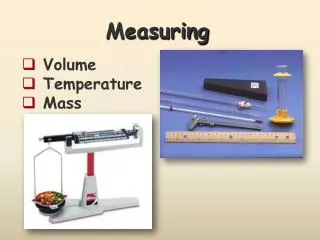
Measuring Measuring Length, Mass, and Volume
How long is the following? Ans. 7.7 cm
How long is the following? Ans. 13.1 cm or 13.17 cm How do we determine the second measurement?
How long is the following? Ans. 11.9 cm
How long is the following? Ans. 26.1 cm
How long is the following? Ans. 19.7 cm
How long is the following? Ans. 18.7 cm
How long is the following? Ans. 14.4 cm
How long is the following? Ans. 0.8 cm
What is the volume? Ans. 51 mL
What is the volume? Ans. 37 mL
What is the volume? Ans. 73 mL
What is the volume? Ans. 18.2 mL
What is the volume? Ans. 51 mL
What is the volume? Ans. 6.4 mL
What is the volume? Ans. 8.2 mL
What is the volume? Ans. 68 mL
What is the mass? Ans. 164.8 g
What is the mass? Ans. 324.4 g
What is the mass? Ans. 45.7
What is the mass? Ans. 2.9