Precise Measurement Techniques: Mass, Volume, and Length Explained
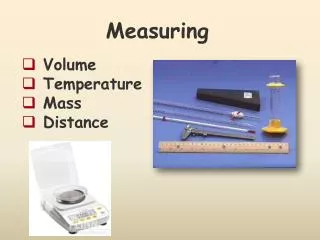
This guide provides a comprehensive overview of how to achieve precise and accurate measurements of mass, volume, and length. Learn the step-by-step methods for using a balance to measure mass, properly reading the meniscus in a graduated cylinder for volume, and effectively utilizing a metric ruler for measuring length. Each technique emphasizes the importance of accuracy and careful observation, ensuring reliable results in any measurement task.

Precise Measurement Techniques: Mass, Volume, and Length Explained
E N D
Presentation Transcript
1. Measuring How to be
PRECISE and ACCURATE
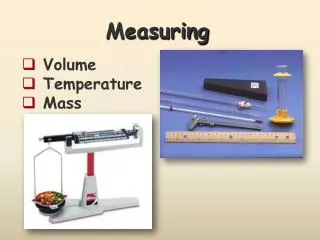
2. How to Measure MASS
4. Place an object on the pan.
Slide the rider with the largest mass along its beam until the pointer drops below zero.
Move it back one notch.
Repeat the process on each beam until the pointer stays at zero.
Add the masses on each beam to find the mass of the object.
6. How to Measure VOLUME
8. A meniscus is the curve of the surface of the water in a graduated cylinder.
Water "sticks" to the walls of the graduated cylinder, but only on the sides and not the middle.
When you look at the surface, the water level is not straight – it’s curved like a smile.
9. Measurement should be at the BOTTOM of the meniscus.
Read the meniscus at eye level in to get an accurate reading. read the meniscus at eye level.
10. How to Measure LENGTH
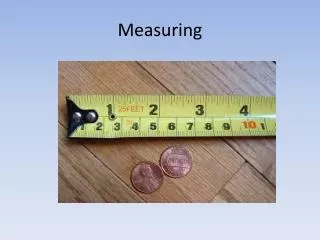
11. Most metric rulers have lines indicating centimeters and millimeters.
The centimeter lines are the longer, numbered lines.
The shorter lines are millimeter lines.
When you use a metric ruler, line up the 0-centimeter mark with the end of the object being measured.