
3.9 Proving Trig Identities
E N D
Presentation Transcript
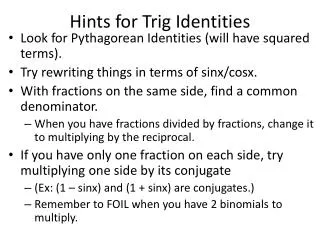
Using fundamental identities (from 3-8), we can prove other identities Best way is to start with one side and manipulate algebraically or use fundamental identities to get it to be equivalent to other side Note: There are no “hard fast” rules to adhere to… sometimes we just have to try something. Hints: – try writing in its component parts or reciprocal – add fractions (common denominator) – multiply fraction by conjugate of bottom – utilize Pythagorean identities If it asks for a “counterexample” you need to find justone value that it will notworkfor. (it might actually work for some values – so think about your choice) (all sines & cosines)
Let’s try some!!! There are 6 problems around the classroom. Work your way around the room doing as many problems as you can Use your friends for help
Homework #309 Pg 174 #1–49 odd
Ex 1) Prove: Work more complicated side
Ex 2) Prove: Work this side Write in terms of sinϕ & cosϕ • PythagIdent • (cos2θ + sin2θ = 1)
Work this side Ex 3) Prove: Mult by conj of bottom • Pythag identity (cos2θ + sin2θ = 1) 1 secθ & cosθ are reciprocals!
Work this side Ex 4) Prove: Write tanθ in terms of sinθ & cosθ cscθ & sinθ are reciprocals! • Use Pythag identity (cos2θ + sin2θ = 1) cosθ & secθ are reciprocals!
Ex 5) Show that sin(β + θ) = sinβ + sinθ is not an identity. You just need 1 counterexample. There are lots of answers!! Here is just one: LHS: RHS:
Ex 6) Prove: Work this side Diff of 2 squares 1 Pythag identity (cos2θ + sin2θ = 1)