
Announcements
E N D
Presentation Transcript
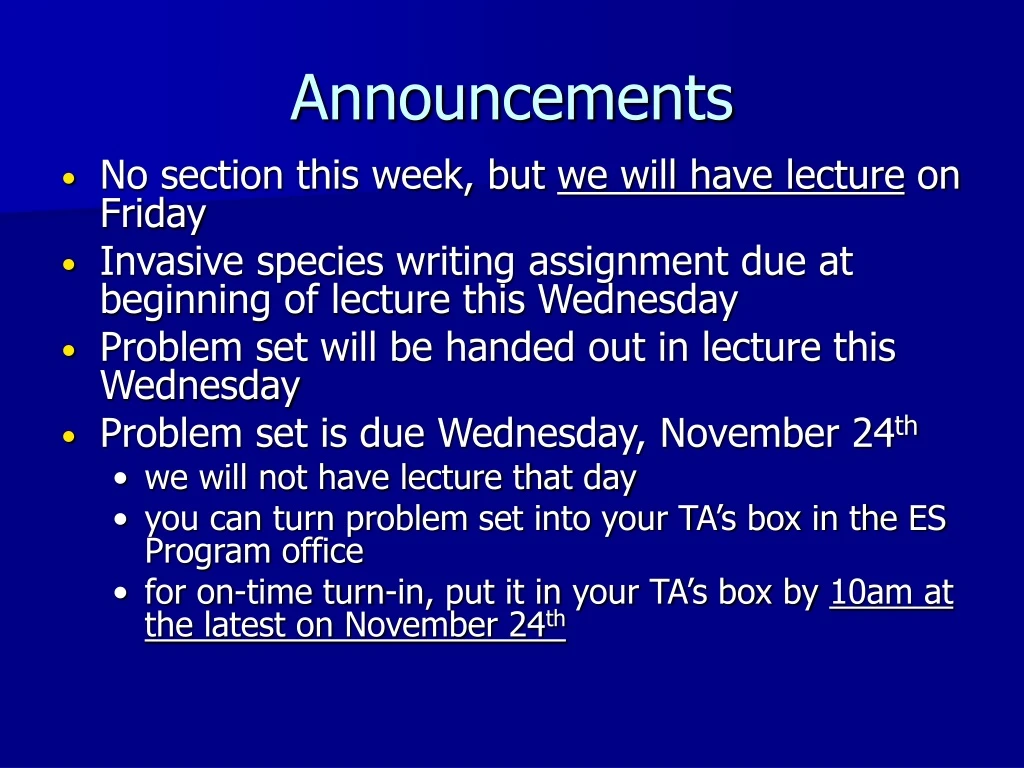
Announcements • No section this week, but we will have lecture on Friday • Invasive species writing assignment due at beginning of lecture this Wednesday • Problem set will be handed out in lecture this Wednesday • Problem set is due Wednesday, November 24th • we will not have lecture that day • you can turn problem set into your TA’s box in the ES Program office • for on-time turn-in, put it in your TA’s box by 10am at the latest on November 24th
Summary from Friday • Metapopulation Theory • subpopulations • maintenance of genetic diversity • source and sink populations • controls on immigration • Invasive Species • definition of terms • why invasive species are successful • problems with invasive species
How can they be stopped? • Physical removal • slow and costly • leaves some to recolonize • Chemical eradication • can harm natives • expensive • Biocontrol • may not work • can create a bigger problem than you solve
Global Change • What will the world be like in 100 years? • Population growth • Land use/cover change • Climate change
With this kind of exponential growth, when will we reach carrying capacity?
Human Population Growth • The maximum biological carrying capacity for humans = 50,000,000,000 • this figure assumes that all primary production is consumed by people…is this possible?
Human Population Growth • The maximum biological carrying capacity for humans = 50,000,000,000 • this figure assumes that all primary production is consumed by people…is this possible? So, what is a more meaningful estimate of carrying capacity?
Human Population Growth • The maximum biological carrying capacity for humans = 50,000,000,000 • this figure assumes that all primary production is consumed by people…is this possible? So, what is a more meaningful estimate of carrying capacity? 8 to 16 billion people
Slowing the growth • What is the most effective way? • provide access to birth control • raise standard of living • education
Why does population matter? • More people will need space, food, and other materials • land clearing • habitat destruction • increased emissions of greenhouse gasses • CO2 carbon dioxide • CH4 methane • N2O nitrous oxide
Land use and land cover change • Deforestation • Desertification
Greenhouse gases and global warming • industrialization = higher emissions • gases trap heat in the lower atmosphere CO2
Secondary effects of warming • Heat can alter hydrological cycles • melting of ice caps • rise in sea level • evaporation • cooling in certain areas • movement of air: wind • storms
Human Population (size and resource use) Industry Agriculture CO2 increase Nitrogen cycle Land use and cover change Global climate change Loss of biological diversity
Studying climate change What happens? • Add CO2 • Add heat
Announcements • Invasive species writing assignment due now • No section this week, but we will have lecture on Friday • Make sure to get the problem set today • Problem set is due Wednesday, November 24th • we will not have lecture that day • you can turn problem set into your TA’s box in the ES Program office • for on-time turn-in, put it in your TA’s box by 10am at the latest on November 24th
Summary from Monday • Global change • Population growth • why it matters • carrying capacity for humans • how to slow the growth • Land use and land cover change • deforestation • desertification • Climate change • increased CO2 emissions by human activity • studying climate change
Global change community change • Different species have different responses • elevated CO2 and C4 vs. C3 plants
Global change community change • Different species have different responses • elevated CO2 and C4 vs. C3 plants • water use and drought-tolerant plants • heat stress
potential survival, but stressed potential survival, but stressed Success intolerant intolerant optimum Temperature
Global change community change • Different species have different responses • elevated CO2 and C4 vs. C3 plants • water use and drought-tolerant plants • heat stress
Global change community change • Different species have different responses • elevated CO2 and C4 vs. C3 plants • water use and drought-tolerant plants • heat stress • With a change in community, biodiversity may… • increase • decrease • stay the same
What is biodiversity? Biodiversity = variation in living things • Genetic diversity • Species diversity • Species richness: # of species • Species evenness: how #’s are distributed • Growth-form diversity • Community diversity • How is biodiversity measured?
Measuring Biodiversity • Count the # of species present • Count the # of families represented • Look for different “functional groups”
Distribution of Biodiversity • general increase from poles to equator
Bird species in North America Diversity increases from pole to equator for many species. Why?
Diversity in the Tropics • 50-80% of today’s species live in tropical rainforest • high temp. and rainfall in tropics • many species rely on trees • however, tropical forests in Africa not as diverse as those elsewhere other drivers of biodiversity aside from climate
Distribution of Biodiversity • general increase from poles to equator Must also consider: • history • productivity of the system • habitat structure • specialization of species • survival of specialists
History • Most of Earth’s land mass was once tropical • Evolution of flowering plants in tropics increased diversity of: plants insects mammals • When Earth’s climate cooled, some species at high latitudes went extinct
Productivity • Tropics are near the equator • Sun’s rays are direct high productivity • More energy at the bottom of the food chain means more species can be supported With more energy, 16 niches are possible With less energy, only 8 niches exist
Habitat Structure • diverse structure more biodiversity • multi-aged stands of trees • epiphytes • gaps • physical structure provides • feeding surfaces • nesting sites • microclimates
Specialization • constant presence of food in tropics • migration not necessary in tropics • certain specialized feeding strategies that are not possible in temperate regions work in the tropics
Survival of Specialists • temperate regions have been glaciated several times in the past 2 million years
Survival of Specialists • temperate regions have been glaciated several times in the past 2 million years • with every ice age, glaciers scour temperate regions and primary succession must take place • generalists are more successful than specialists in temperate zones
Why is biodiversity important? Genetic diversity • Long term survival requires responsiveness to small changes in the environment • Prevent genetic bottleneck Population size Genetic diversity Time
Conserving a viable population Goal of conservation: maintain a MVP MVP: minimum viable population • it is difficult to know what this number is With too few mating pairs: • inbreeding depression:lowered fitness of offspring • genetic drift: random loss of alleles from the genetic pool
Why is biodiversity important? Species Diversity • Ethical Reasons • some believe in a universal right to exist • aesthetic, spiritual, or other intrinsic value • Practical Reasons • medicines • pest control • ecosystem services
Announcements • Pick up the problem set from your TA if you don’t have it already • Problem set is due Wednesday, November 24th by 10am in your TA’s box • No section this week
Summary from Wednesday • Global change drives community change • Biodiversity • increases from poles to equator • higher temp. and rainfall in tropics • other drivers: • history • productivity • structure • specialization • survival of specialists • Why is biodiversity important?
Ecosystem Services • Primary production for food, forage, fiber
Ecosystem Services • Primary production for food, forage, fiber • Control of water dynamics • flood control • water purification
Ecosystem Services • Primary production for food, forage, fiber • Control of water dynamics • flood control • water purification • Pollination
Ecosystem Services • Primary production for food, forage, fiber • Control of water dynamics • flood control • water purification • Pollination • Regulation of nutrient distribution • CO2 uptake and C sequestration but how does biodiversity matter?
Control of ecosystem services Redundancy • more than one species has a similar “job” • if one goes extinct, the others compensate Atta sexdens Atta cephalotes