SlideServe
Menu
Préférences
© SlideServe · v2026

Development

ralph-travis avatar
26 diapositives · 442 Views · Nov 03, 2014

This PowerPoint presentation serves as a comprehensive guide for brainstorming on the topic of development. It explores the stages of development across nations, distinguishing between LEDCs, MEDCs, NICs, and RICs. The presentation details various measurement indicators, including economic and social factors, and highlights key concepts like the North/South divide and the Brandt Line. Case studies from countries such as Ghana and Lesotho illustrate the challenges and successes in development, with an emphasis on education, clean water access, and sustainable projects.
Development - slide 1
01 / 26Development
1 / 17

Télécharger la présentation

Development
Une image / un lien ci-dessous est fourni (tel quel) pour télécharger la présentation

Politique de téléchargement : le contenu du site vous est fourni TEL QUEL pour votre information et votre usage personnel ; il ne peut être vendu, concédé sous licence ni partagé sur d’autres sites sans l’accord de son auteur.Le contenu vous est fourni TEL QUEL, pour votre information et votre usage personnel uniquement. Téléchargez la présentation en cliquant sur ce lien. Lors du téléchargement, si vous ne parvenez pas à télécharger une présentation, l’éditeur a peut-être supprimé le fichier de son serveur.Pendant le téléchargement, si vous ne parvenez pas à obtenir une présentation, le fichier a peut-être été supprimé par l’éditeur.

F I N

Plus de contenu associé

Transcription de la présentation
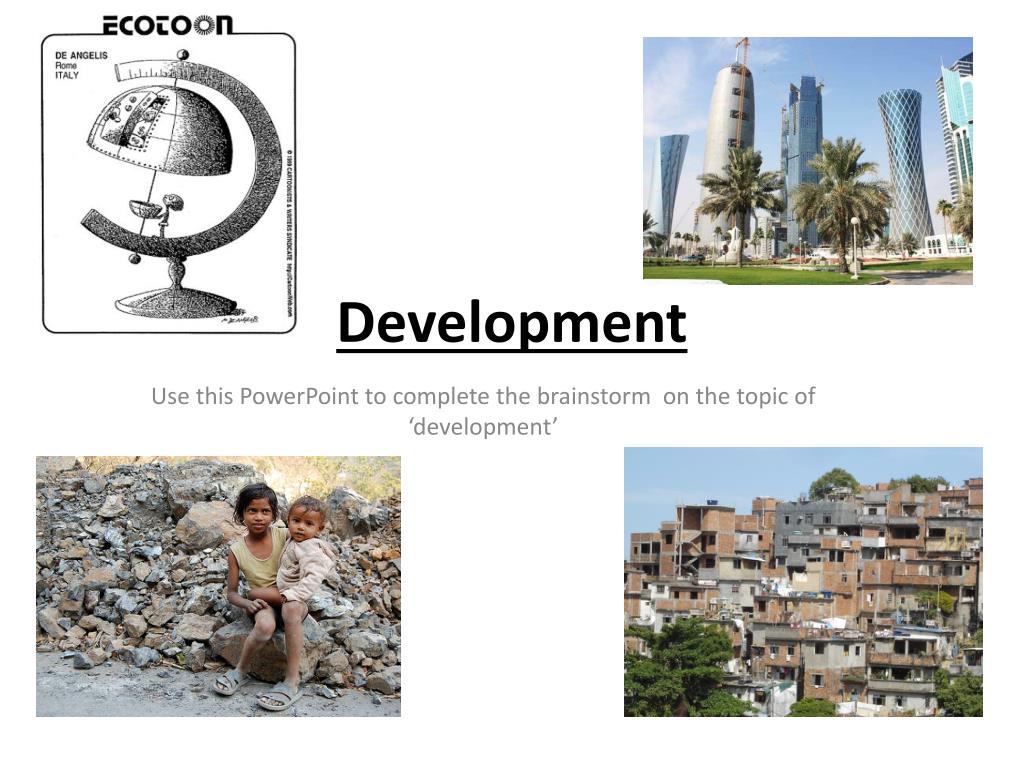
  1. Development Use this PowerPoint to complete the brainstorm on the topic of ‘development’

  2. Key words • Development is the process of change which improves the well being of society in terms of material wealth and quality of life. Countries are in different stages of development • LEDC’s are less economically developed countries • MEDC’s are more economically developed countries • NICs – newly industrialising countries • RICs – recently Industrialised Countries

  3. Measures of development • Lots of different ways development can be measured. • Can be spilt into economic (money) and social (people) indicators Video - http://www.bbc.co.uk/schools/gcsebitesize/geography/development/contrasts_development_video.shtml

  4. Measures of development

  5. Global pattern of Development • North/ South divided • Brandt Line – 1980’s divided the world into a rich north and poor south

  6. Global pattern of Development This line is know becoming increasingly out of date as more countries are starting to develop India, China and Brazil ???

  7. Regional patterns of development Case-study Ghana • Ghana is a sub Saharan country • The GNI is $770 per person • It is an LEDC • 45% of the population live on less than $1 a day • 19% of children are malnourished • There is a north south divided within the country • Rich south and poor north

  8. Make sure you can do a quick sketch map of Ghana (remember you will only get 1 mark – so do not do a detailed map ) Get the shape right and label the capital city and surrounding countries

  9. North South Divide- Facts Facts you can use in the exam to show knowledge of case-studies

  10. Causes of north/south divide South • Has a coastline this has allowed the southern regions to trade easily through shipping ports. • The coast has also attracted tourism to the southern regions. • Has better infrastructure and industry has developed here. North • North has a harsher climate and unreliable rainfall, this means that farming is also unreliable.

  11. Millennium Development Goals Videos https://www.youtube.com/watch?v=Sj6q0Apd_cs https://www.youtube.com/watch?v=v3p2VLTowAA

  12. Progress – South Asian Countries • Progress slower than other regions (apart from Africa) • 3% drop in extreme poverty (49% to 39%) • A good 11% gain in primary school enrolment • Cut in half the proportion of people without access to clean drinking water • Although 580 million people without sanitation • Infant mortality was 7-11%

  13. Progress –Sub Saharan Africa • Made the least progress • Number of people hungry has gone down from 32% (1990) to 28% - however this is too slow

  14. Aid Video - http://www.bbc.co.uk/schools/gcsebitesize/geography/development/aid_video.shtml

  15. Aid

  16. Casestudy - Lesotho Highlands Water Project • Large scale scheme to transfer water from Lesotho to South Africa (city of Johannesburg) • Shortage of clean water in Johannesburg (South Africa) • Lesotho is one of the world poorest countries, with no natural resources to sell apart from water • Scheme involved building 200km long system of tunnels and 6 dams • Cost = $8 Billion • Funded by a loan from the world Bank

  17. Lesotho is shaded in yellow. It is located within the country of South Africa

  18. Lesotho Highlands Water Project

  19. Casestudy - Small scale water project – Oxfam, WaterAid and Rural Aid • Access to clean water and sanitation facilities in Ghana is low, particularly in rural areas. • Oxfam, WaterAid and Rural Aid (NGO’s) worked with local communities to construct hand dug wells with pumps • The project involved local people in the constructions • Uses appropriate technology • One village to benefit from the well was Asamponbisi Village Video - http://www.bbc.co.uk/learningzone/clips/finding-and-collecting-water-in-africa/542.html

  20. Small scale water project – Oxfam, WaterAid and Rural Aid

  21. Casestudy - Oxfam Primary education project • 100% of children attend school in MEDCs in LEDC many children are not able to go to school, the main reason for this is poverty. • There has been a particular focus on improving education for girls. This is because: - • Girls are less likely to be educated • the child of an uneducated mother is twice as likely to die (infant morality G4) • Educated women are more likely to have a smaller family (reduces poverty G1) • Empowers women (gender equality G3)

  22. Oxfam Primary education project • Long term development project • Aims to provide support for primary school to Ghana • Communities here are pastoral farmers – very poor and cant afford to send their children to school • Project supports 48 primary schools • Outcomes: - • 4053 enrolled at school (45% of these were girls) • Women involved in the management of school G3 • Ration of books per pupil improved (from 1/5 to 2/3)

  23. Large scale project vs Small scale NGO’s in recent times tend to stick to small scale development projects. Even through these only benefits relatively small numbers of people. Small scale projects are generally run by local people and there fore do not have such a great impact on the environment and people living in an area. Small scale project = sustainable