Comprehensive Guide to Measuring AC and DC Voltage with Multimeters
110 likes | 233 Vues
This guide provides essential details on measuring AC and DC voltage, resistance, and current using multimeters. It covers voltage ranges up to 1000 volts for AC and DC, as well as millivolt measurements up to 400 millivolts. Learn the correct procedures for Ohm's resistance testing and diode testing, including the importance of turning off power where needed. We also address common setup errors to ensure accurate measurements, including switching positions and lead placements. Master multimeter usage with practical tips and best practices.


Comprehensive Guide to Measuring AC and DC Voltage with Multimeters
E N D
Presentation Transcript
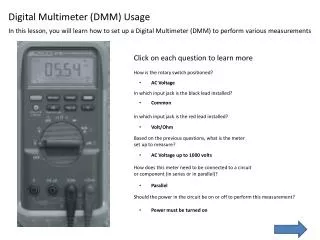
AC Voltage • Common • Volt/Ohm • AC Voltage up to 1000 volts • Parallel • Power must be turned on
DC Voltage • Common • Volt/Ohm • DC Voltage up to 1000 volts • Parallel • Power must be turned on
DC millivolt • Common • Volt/Ohm • DC millivolts up to 400 millivolts • Parallel • Power must be turned on
Ohms • Common • Volt/Ohm • Resistance displayed in Ohms • Parallel • Power must be turned off
Diode Test • Common • Volt/Ohm • Diode barrier voltage • Parallel • Power must be turned off
Milliamp/amp • Common • Amp • Current up to 10 amps • Series • Power must be on
Milliamp/amp • Common • milli/microamp • Current up to 400 milliamps • Series • Power must be on
microamp • Common • Milli/microamp • Current up to 4000 microamps • Series • Power must be on
DC Volts • Common • Amp • Incorrect switch/lead position • The meter needs to be set up properly first • The meter needs to be set up properly first
Ohm • Amp • Volt/Ohm • Incorrect black lead position • The meter needs to be set up properly first • The meter needs to be set up properly first
Milliamp/amp • Common • Volt/Ohm • Incorrect switch/lead position • The meter needs to be set up properly first • The meter needs to be set up properly first