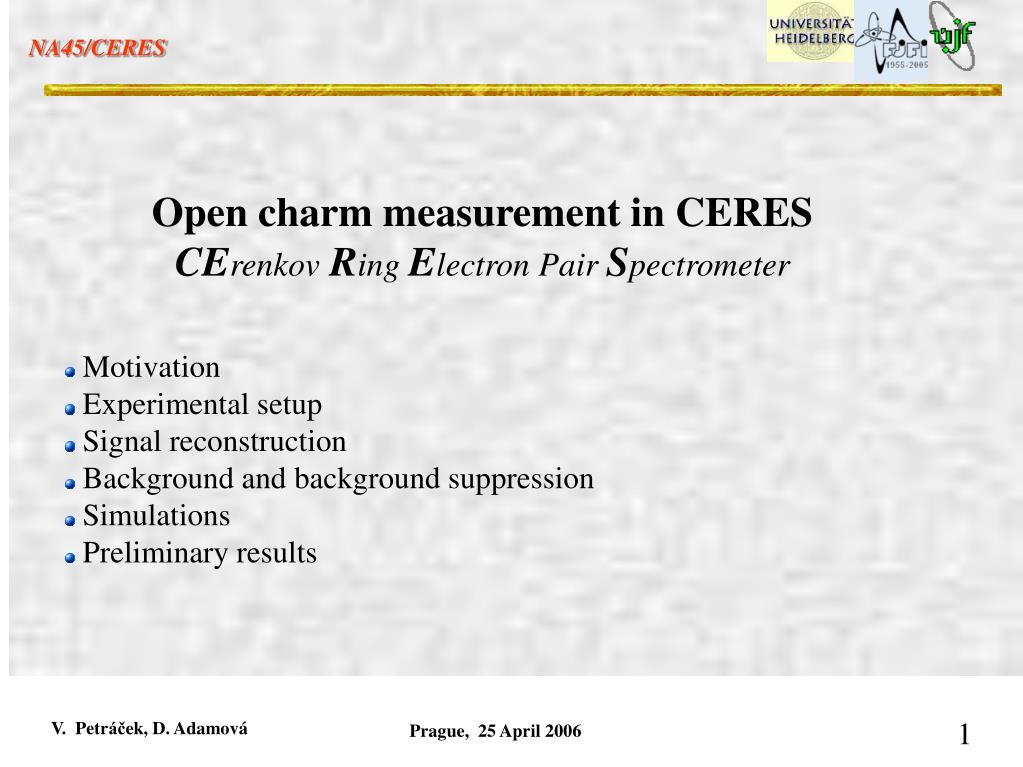
This study focuses on the measurement of open charm production in the CERES experiment at CERN's SPS. Open charm quarks, primarily generated from parton fusion and early stage collisions, serve as vital probes for understanding the Quark-Gluon Plasma. We delve into experimental setups, signal reconstruction methods, and background suppression strategies. Simulations and preliminary results highlight the charm quark's characteristics and energy loss mechanisms in a medium, offering insights into its role in probing QGP properties and establishing baselines for J/ψ measurements.
01 / 63Open Charm Measurement in CERES: Exploring Quark-Gluon Plasma and Charm Quark Dynamics
1 / 17
Télécharger la présentation
Open Charm Measurement in CERES: Exploring Quark-Gluon Plasma and Charm Quark Dynamics
Une image / un lien ci-dessous est fourni (tel quel) pour télécharger la présentation
Politique de téléchargement : le contenu du site vous est fourni TEL QUEL pour votre information et votre usage personnel ; il ne peut être vendu, concédé sous licence ni partagé sur d’autres sites sans l’accord de son auteur.Le contenu vous est fourni TEL QUEL, pour votre information et votre usage personnel uniquement.Téléchargez la présentation en cliquant sur ce lien.Lors du téléchargement, si vous ne parvenez pas à télécharger une présentation, l’éditeur a peut-être supprimé le fichier de son serveur.Pendant le téléchargement, si vous ne parvenez pas à obtenir une présentation, le fichier a peut-être été supprimé par l’éditeur.
F I N
Plus de contenu associé
Transcription de la présentation
Open charm measurement in CERES CErenkov RingElectronPairSpectrometer Motivation Experimental setup Signal reconstruction Background and background suppression Simulations Preliminary results
Motivation I Charm quark mostly produced from the initial fusion of partons (mostly gluons) Open charm production sensitive to initial parton distribution functions 2001, Dokshitzer and Kharzeev proposed “dead cone” effect => charm quark small energy loss, but in vacuum Recent: Heavy quark energy loss in medium, e.g.: Armesto et al, PRD 71, 054027, 2005; M. Djordjevic et al., PRL 94, 112301, 2005. Z. Lin & M. Gyulassy, PRC 51 (1995) 2177 light 3
Motivation II Charmed quarks produced in the initial hard parton scattering and at the very early stages of the collisionOne of the methods for probing the properties of the Quark-Gluon Plasma essential as a baseline for J/ measurements natural baseline B J/ background open flavours B,D quarkonia J/, suppression Medium probes: early formation energy loss K e
Motivation for Open Charm Analysis in CERES Main CERES features CERES/NA45: one of the second generation heavy ion experiments at CERN SPS. Dedicated to the study of e+e- pairs in relativistic nuclear collisions. Precise Si Drift vertex telescope Pair of RICH detectors with thr=32 (e-veto, with P>4.5 GeV, K id) 2 azimuthal acceptance Acceptance in y 2.11-2.66 P measurement from deflection ('96), TPC (2000) Open charm reconstruction strategy Reconstruction of 3-body decays of charged D mesons D K, D KK, Ds KK, D cascades via K*(892) and K*(1430) Better chances for D (c=317m) , low for Ds (c=167m) and D0(c=124m)
Primary vertex resolution and matching in SiDC telescope Primary vertex z = 246 m SiDC 1,2 matching =0.42 mrad SiDC 1,2 matching =1.7 mrad With single anode hit =4.5 mrad Good reason to separate in reconstruction and information
Reconstruction of displaced track Hit association Predictor from SiDC1 and SiDC2 hits PaDC hit association ( matching window 2.5 mrad) (or matching to TPC track) Electron rejection Rejection of tracks with identical segment in SiDC or PaDC Rejection of tracks containing split hits in SiDC Primary track suppression
Relation between displaced track and projection Reconstruction of SV position using projections 3 pairs of tracks for each 3-vertex Each pair defines a line as allowed SV position From these 3 lines, SV can be determined SV position was reconstructed without using the information on d SiDC1,2 This information is used later in candidate selection, where d measured is compared with d predicted using the reconstructed SV position.
Selection criteria for SV candidates Difference between predicted and measured din SiDC1,2 Impact parameter Physical Dalitz region For unknown mass assignment physical region in Pseudo-Dalitz plot Momentum conservation Product momenta Reconstructed D momentum
Analysis framework Pa = 158 GeV T = 175 MeV * yCM = 2.95 y = 1.2 URQMD Assumes no flow !
1996 data set and data handling • Approx. 5380 data files of average size 0.4 GB 2.15 TB of data • Altogether over 42 millions of events to be processed (31.7 done) • Transferred from CERN CASTOR to Prague • Stored partly on the computing cluster of CTU and partly on computing farm GOLIAS • The analysis used the original CERES software adapted to Linux RedHat, kernel 2.4.22 (it was not quite easy!) • The data files already processed archived on external USB discs to free space for the output files from the analysis, due to neverending fight over space on disc storage • ¾ of data already processed in first and second analysis pass, last ¼ is currently under processing
Invariant mass reconstruction (in KDG) With ideal dP/P (and/or with =0.. ) is reconstructed mass independent on PD DP/P parametrization 96 Invariant mass slope corrected dM/M 6.8% For dP/P resolution from 2000 is this dependence negligible
Effect of min. product momentum cut on reconstructed invariant mass peak For Pprod >1.75 GeV, the admixture of fake tracks is largely eliminated In the full analysis We use Pprod >1.2 GeV
Spatial precision of SV reconstruction Comparison of MC only with decay products and overlay MC All D decayed at SV z=0.4cm SV x,y determined from direction of PD z=242 m (FMC) z=305 m (OVL)
Definition of signal and background charge topologies for 3-body decays of D problem of random track mixing Signal can be >>enhanced<< due to the random track admixture . Some SV candidates with random track may pass selection criteria Contribution from Ds partial reconstruction is unlikely to happen Only the real D SV can produce sometimes more SV candidates in the same event. Background DOES NOT produce SV candidates with mass concentrated in D invariant mass peak!
Set of cuts used in analysis Zsv > 0.2 cm Impact parameter < 0.035 cm Sum of differences between measured and predicted dSiDC1,2 < 5.5 mrad Pprod <1.2 - 8> GeV Cut in pseudo-Dalitz plane m12+m23 < 2.25 GeV Product <140 - 240> mrad D <0 - 240> mrad
Momentum conservation, invariant mass and momentum transfer Ideal dP/P used - for better understanding of reflections K mass assignment assumed D KK produces the left side band in inv. Mass With dP/P (96) this band can not be distinguished from the main K peak
Mass spectra for D family decays - ideal dP/P Decays fulfilling cuts (dominantly D) reconstructed in different mass assignments D KK and D K forming peak/band in corresponding mass assignments All ZSV
Contributions from different D family members fulfilling cuts Signal is for Zsv > 0.2 cm dominated by D Contribution from Ds <10% D0 contribution is negligible D Ds D0 K mass assignment
Possible background from other 3-body decays In the mass range 1.5 – 2.2 GeV may contribute and particles. The former via decay to decaying to p so fast, that it seems like 3-vertex The later produced in next target but with momentum vector as if it comes from PV Both constraints supress admixtude of and deep below expected D yield
Study of signal contamination Invariant mass spectra for signal and contamination Dalitz distributions for signal and possible contamination
Pt spectra of signal and background • Signal & Background integrated • in the interval 1.5 – 2.2 GeV • Pt spectrum of signal is “harder” • then for background • There is very little signal for low • Pt (note that this is integral scan) • Indication of radial flow of the heavy object
Connexion au compte
Connectez-vous pour publier votre contenu sur SlideServe.