Download
1 / 67
670 likes | 773 Vues
This guide provides a comprehensive overview of carbohydrates, emphasizing monosaccharides, their classifications, and structural representations such as Fischer and Haworth projections. It details the characteristics of aldoses and ketoses, explains mutarotation, and outlines the significance of glucose assays in clinical chemistry. Furthermore, it explores glycosides and their formation, highlighting their role in biochemistry. By presenting key terms and concepts related to carbohydrates, this resource serves as an essential reference for students and professionals in the field of chemistry and biology.

E N D
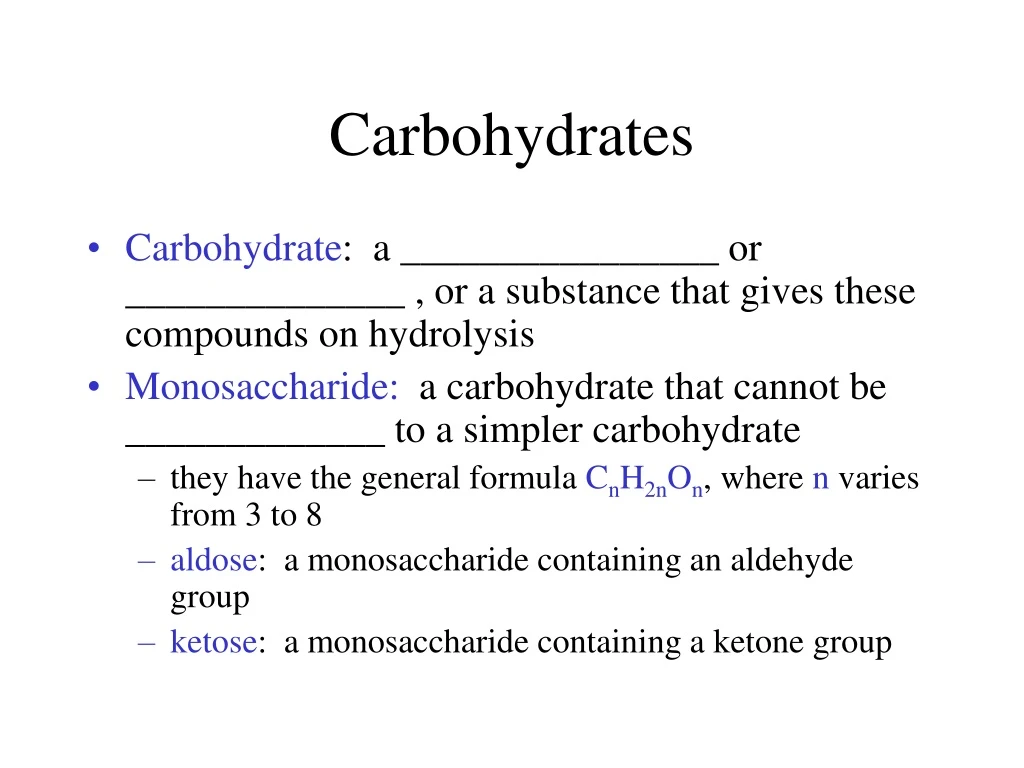
Carbohydrates • Carbohydrate: a ________________ or ______________ , or a substance that gives these compounds on hydrolysis • Monosaccharide: a carbohydrate that cannot be _____________ to a simpler carbohydrate • they have the general formula CnH2nOn, where n varies from 3 to 8 • aldose: a monosaccharide containing an aldehyde group • ketose: a monosaccharide containing a ketone group
d:\gob.exe Go to GOB slide 2 – classifying carbohydrates
Monosaccharides • There are only two trioses • often aldo- and keto- are omitted and these compounds are referred to simply as trioses; although this designation does not tell the nature of the carbonyl group, it at least tells the number of carbons
Monosaccharides • Glyceraldehyde contains a stereocenter and exists as a pair of enantiomers
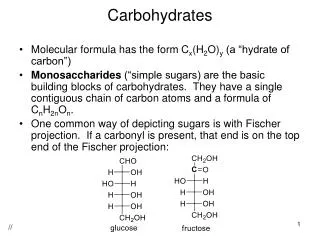
Fischer Projections • Fischer projection: a two dimensional representation for showing the configuration of tetrahedral __________________ • ____________ lines represent bonds projecting forward • vertical lines represent bonds projecting to the ______
D,L Monosaccharides • In 1891, Emil Fischer made the arbitrary assignments of D- and L- to the enantiomers of glyceraldehyde
D,L Monosaccharides • According to the conventions proposed by Fischer • D-monosaccharide: a monosaccharide that, when written as a Fischer projection, has the -OH on its ___________ carbon on the right • L-monosaccharide: a monosaccharide that, when written as a Fischer projection, has the -OH on its penultimate carbon on the ______
D,L Monosaccharides • Following are the two most common D-aldotetroses and D-aldopentoses
D,L Monosaccharides • and the three common D-aldohexoses. Note that one of these is an amino sugar
Cyclic Structure • Monosaccharides have hydroxyl and carbonyl groups in the same molecule and exist almost entirely as five- and six-membered cyclic ______________ • __________ carbon: the new stereocenter resulting from cyclic hemiacetal formation • _______ : carbohydrates that differ in configuation at their anomeric carbons
Haworth Projections • Haworth projections • five- and six-membered hemiacetals are represented as planar ________ or ________ , as the case may be, viewed through the edge • most commonly written with the ________ carbon on the right and the hemiacetal oxygen to the back right • the designation ___ means that -OH on the anomeric carbon is cis to the terminal -CH2OH; ___ means that it is trans
d:\GOB.exe Go to GOB slide 3
Mutarotation • Mutarotation: the change in specific rotation that occurs when an a or b form of a carbohydrate is converted to an equilibrium mixture of the two
Mutarotation: the change in specific rotation that occurs when an a or b form of a carbohydrate is converted to an equilibrium mixture of the two
Reduction to Alditols • The carbonyl group of a monosaccharide can be reduced to an hydroxyl group by a variety of reducing agents, including NaBH4 and H2/M
Oxidation to Aldonic Acids • Oxidation of the -CHO group of an aldose to a -CO2H group can also be carried out using Tollens’, Benedict’s, or Fehling’s solutions
Oxidation to Aldonic Acids • 2-Ketoses are also oxidized by these reagents because, under the conditions of the oxidation, 2-ketoses equilibrate with isomeric _________
Glucose Assay • The analytical procedure most often performed in the clinical chemistry laboratory is the determination of glucose in blood, urine, or other biological fluid • this need stems from the high incidence of diabetes in the population
Glucose Assay • The glucose oxidase method is completely specific for D-glucose
Glucose Assay • the enzyme glucose oxidase is specific for b-D-glucose • molecular oxygen, O2, used in this reaction is reduced to hydrogen peroxide H2O2 • the concentration of H2O2 is determined experimentally, and is proportional to the concentration of glucose in the sample • in one procedure, hydrogen peroxide is used to oxidize o-toluidine to a colored product, whose concentration is determined spectrophotometrically
Glycosides • _________ bond: the bond from the anomeric carbon of the glycoside to an -OR group • __________ are named by listing the name of the alkyl or aryl group attached to oxygen followed by the name of the carbohydrate with the ending -e replaced by -ide • methyl b-D-glucopyranoside • methyl a-D-ribofuranoside
Formation of Glycosides • Glycoside: a carbohydrate in which the -OH of the anomeric carbon is replaced by -OR Methyl b-D-glucopyranoside (methyl b-D-glucoside)
Fig 19.UNa, p.475 Fig 19.UNb, p.476
d:\GOB.exe Go to GOB slide 5
The –OR group of the glycoside may be another monosaccharide – the resulting glycoside is then a disaccharide Examplesof important disaccharides follow:
Maltose • From malt, the juice of sprouted barley and other cereal grains
Lactose • The principle sugar present in milk • about 5% - 8% in human milk, 4% - 5% in cow’s milk
Sucrose • Table sugar, obtained from the juice of sugar cane and sugar beet