

SlideServe
Menu
Préférences
© SlideServe · v2026

Alexander Flemming

regis avatar
6 diapositives · 554 Views · Jul 17, 2014

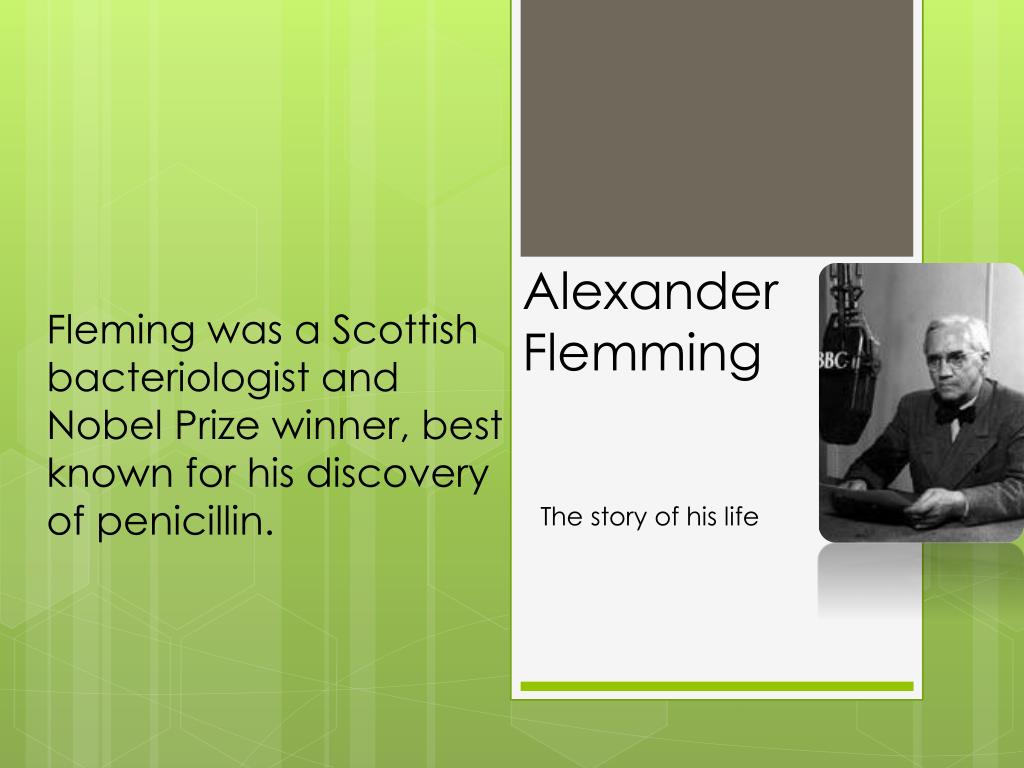
Fleming was a Scottish bacteriologist and Nobel Prize winner, best known for his discovery of penicillin. Alexander Flemming. The story of his life. Who is alexander Flemming.
Alexander Flemming - slide 1
01 / 6Alexander Flemming
1 / 17

Télécharger la présentation

Alexander Flemming
Une image / un lien ci-dessous est fourni (tel quel) pour télécharger la présentation

Politique de téléchargement : le contenu du site vous est fourni TEL QUEL pour votre information et votre usage personnel ; il ne peut être vendu, concédé sous licence ni partagé sur d’autres sites sans l’accord de son auteur.Le contenu vous est fourni TEL QUEL, pour votre information et votre usage personnel uniquement. Téléchargez la présentation en cliquant sur ce lien. Lors du téléchargement, si vous ne parvenez pas à télécharger une présentation, l’éditeur a peut-être supprimé le fichier de son serveur.Pendant le téléchargement, si vous ne parvenez pas à obtenir une présentation, le fichier a peut-être été supprimé par l’éditeur.

F I N

Plus de contenu associé

Transcription de la présentation
  1. Fleming was a Scottish bacteriologist and Nobel Prize winner, best known for his discovery of penicillin. Alexander Flemming The story of his life

  2. Who is alexander Flemming Alexander Fleming was born in Ayrshire on 6 August 1881, the son of a farmer. He moved to London at the age of 13 and later trained as a doctor. He qualified with distinction in 1906 and began research at St Mary's Hospital Medical School at the University of London under Sir Almroth Wright, a pioneer in vaccine therapy. In World War One Fleming served in the Army Medical Corps and was mentioned in dispatches. After the war, he returned to St Mary's.

  3. What were his discoveries • In 1928, while studying influenza, Fleming noticed that mould had developed accidentally on a set of culture dishes being used to grow the staphylococci germ. The mould had created a bacteria-free circle around itself. Fleming experimented further and named the active substance penicillin. It was two other scientists however, Australian Howard Florey and Ernst Chain, a refugee from Nazi Germany, who developed penicillin further so that it could be produced as a drug. At first supplies of penicillin were very limited, but by the 1940s it was being mass-produced by the American drugs industry.

  4. Facts about Alexander Flemming • •When he was twenty, Alexander started a course at St Mary’s Hospital Medical School in Paddington, London. • •His brother, Tom, was also a doctor. • •After completing his medical degree, Fleming joined the research team at St Mary’s. He was the assistant to Sir Almroth Wright, a bacteriologist. • •During World War 1, Alexander Fleming served as a captain in the Royal Medical Corps, working in the battlefield hospitals in France. • •In France, Fleming had witnessed large numbers of soldiers dying from infected wounds. He realised that the antiseptics being used destroyed the patient’s immune system and didn’t effectively stop the invading bacteria. He set about trying to find anti-bacterial agents. • Alexander Fleming

  5. Famous Qoute Alexander Flemming had a Famous quote. This is the quote: • "I certainly didn't plan to revolutionize all medicine by discovering the world's first antibiotic, or bacteria killer. But I suppose that was exactly what I did."

  6. Thank you for listening To my presentation