Advances in Micropaleontology: Insights from Foraminiferal Biostratigraphy and Paleoecology
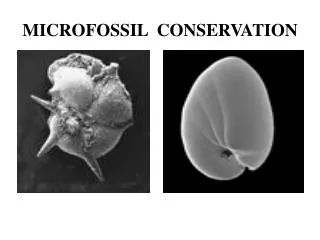
This collection of references explores significant advancements in micropaleontology, particularly focusing on foraminiferal biostratigraphy, biochronology, and their implications for paleoecologic research. Notable contributions include studies on climate changes inferred from planktonic foraminifera, morphological adaptations in marine environments, and their role in trophic structures. The compilation also addresses isotopic signals, dinoflagellate cyst stratigraphy, and the ecological responses of foraminifera through various geological periods, offering vital insights into ancient marine ecosystems.


Advances in Micropaleontology: Insights from Foraminiferal Biostratigraphy and Paleoecology
E N D
Presentation Transcript
Berggen, W. A. (1978):Recent advances in Cenozoic planktic foraminiferal biostratigraphy, biochronology, and biogeography: Atlantic Ocean. Micropaleontology 24: 337-370. • Bignot, G. (1985): Elements of Micropaleontology. Graham & Tortman LTD, London. • Boltovskoy, E. (1973):Reconstruction of post-Pliocene climate changes by means of planktonic foraminifera. Boreas 2, 55-68. • Boltovskoy, E. & Wright, R. (1976): Recent foraminifera. The hague: W. Junk. • Brasier, M. D. (1975):Morphology and habitat of living benthonic foraminiferids from Caribbean carbonate environments. Revta Esp. Micropaleont. 7, 576-578. • Brasier, M. D. (1980): Microfossils. George Allen & Unwin, London, 193 pp • Buzas, M.A. and Gupta, B. K. (eds.,1982):Foraminifera: Notes for a short course. University of Tennessee Department of Geological Sciences Studies in Geology 6. • D'Hondt, S., et al (1994): Stable isotopic signals and photosymbiosis in late Paleocene planktic foraminifera. Paleobiology 20: 391-406. • Dodsworth, P. (2000):Trans-Atlantic dinoflagellate cyst stratigraphy across the Cenomanian-Turonian (Cretaceous) boundary. Journal of Micropaleontology 19:69-84. • Haynes, J. R. (1981): Foraminifera. John Wiley and Sons, New York. • Levine, N. D. (1962): Protozoology today. J. Protozool., 9 (1): 1-6. • Lipps, J. H. & Valentine, J. W. (1970):The role of foraminifera in the trophic structure of marine communities. Lethaia 3, 279-286. • Loeblich, J. H. & Tappan, H. (1964): Protista 2; Sarcodina, chiefly "Thecamoebians" and Foraminiferida. In: Treatise on invertebrate paleontology, part C. R. C. Moore (ed.), (2 vols). Geol. Soc. Am. and Univ. Kansas Press.
Murray, J. W. & Wright, C. A. (1974):Paleogene Foraminiferida and paleoecology, Hampshire and Paris Basins and the English Channel. Spec. Paps Paleont., no. 14 • Neale, J. & Brasier, M. D. (1981):Microfossils from the Recent and Fossil shelf seas. Ellis Horwood Limited. • Ellegaard, M. (2000): Variations in dinoflagellate cyst morphology under conditions of changing salinity during the last 2000 years in the Limfjord, Denmark. Review of Paleobotany and Palynology109: 213-266. • Hallock, P. (1985): Why are larger foraminifera large? Paleobiology11: 195-208. • Harding, I.C. (1998): A minute new cladopyxiinean dinocyst from the Barremian (Cretaceous) and its bearing on the acritarch vs dinoflagellate cyst question. Review of Paleobotany and Palynology100: 89-98. • Gooday, A. J. (1994): The biology of deep-sea foraminifera: A review of some advances and their applications in paleoceanography. Palaios9: 14-31. • Haq, B. U. and Boersma, A. (eds., 1978):Introduction to marine micropaleontology. Elsevier, New York. • Knoll, A. H., et al (1993): Calcified microbes in Neoproterozoic carbonates: Implications for out understanding of the Proterozoic? Cambrian transition. Palaios 8: 512-525. • Lipps, J. H. (ed., 1993):Fossil prokaryotes and protests. Blackwell Scientific Publications, Boston.
Lord, A. R. (ed., 1982):Stratigraphic index of calcareous nannofossils. Ellis Horwood Limited, Publisher, Chcichester, U.K., 192 pp. • Macleod, N. and Keller, G. (1994): Comparative biogeographic analysis of planktic foraminiferal survivorship across the Cretaceous/Tertiary (K/T) boundary. Paleobiology20: 143-177. • Ramsey, A. T. S. (ed., 1977):Oceanic micropaleontology. Academic Press, London • Sarjeant, W.A.S. (1974):Fossil and living dinoflagellates. Academic Press, London, 182 pp. • Signes, M. et al (1993): A model for planktic foraminiferal shell growth. Paleobiology, 19: 71-91. • Song, Y., Black, R. G., Lipps, J. H., (1994): Morphological optimization in the largest living foraminifera: Implications from finite element analysis. Paleobiology20: 14-26. • Vavrdova, M. (1997): Early Ordovician provincialism in acritarch distribution. Review of Paleobotany and Palynology98: 33-40. • Wei, Kuo-Yen (1994): Allometric heterochrony in the Pliocene-Pleistocene planktic foraminiferal clade Globoconella. Paleobiology, 20: 66-84. • Wei, Kuo-Yen (1994): Stratophenetic tracing of phylogeny using SIMCA pattern recognition technique: a case study of the late Neogene planktic foraminifera Globoconella clade. Paleobiology 20: 52-65. • Wicander, R. et al. (1999): Stratigraphic and paleogeographic significance of an Upper Ordovician acritarch flora from the Maquoketa shale, Northeastern Missouri. Paleontological Society Memoir 51.