Enhancing Household Production for Resiliency: Lessons from Urban Gardens in Ethiopia
130 likes | 246 Vues
This document explores the concept of household production, focusing on gardening, agriculture, and vocational training to support low-income households. It presents lessons learned from the Urban Gardens Program in Ethiopia, which implemented community and school gardens across multiple sites. Key findings emphasize the need for adaptive technology, ongoing support, and improved soil management. Challenges such as land tenure and gender inequities are addressed, highlighting the importance of integrating agricultural practices into economic strengthening for vulnerable populations.


Enhancing Household Production for Resiliency: Lessons from Urban Gardens in Ethiopia
E N D
Presentation Transcript
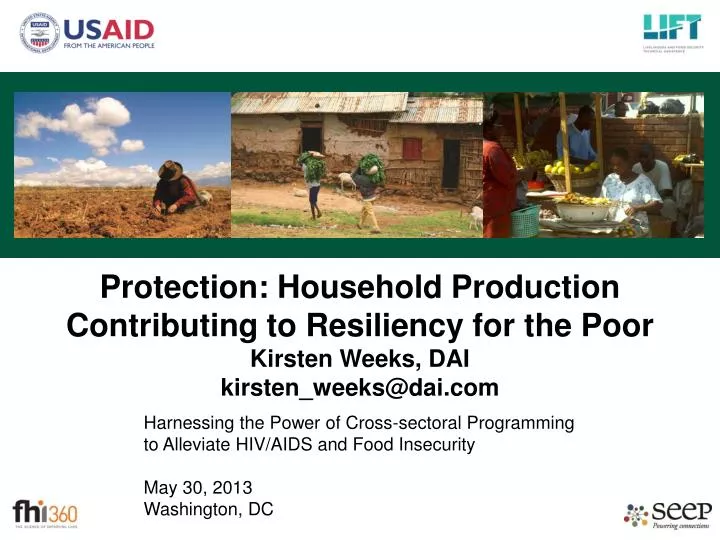
Protection: Household Production Contributing to Resiliency for the Poor Kirsten Weeks, DAIkirsten_weeks@dai.com
Household Production – What do we mean? • Includes household gardening, agriculture, livestock and horticulture, micro-business support, understanding markets, vocational training – linked to job placement. • Increase productive assets • Helps household smooth income and expenses and promote asset growth • Help households increase productivity and income.
Program Experience - Urban Gardens Program (UGP) – Ethiopia • Introduced household, community and school gardens across 136 Community garden sites; 188 school garden sites. • Program Experience as a technical assistance provider IMARISHA – Tanzania; and HICD/R - Rwanda • Providing technical assistance to PEPFAR supported home-based care and OVC partners
UGP Approach • Blend of: Participatory, training and learning “Garden Dialogues” to promote agriculture; Technology: (drip-kits, grow-bags/plasic boxes); and group savings.
UGP Challenges • Push for high targets and rapid graduation of participants – one year of support • Challenges of land tenure • Gender inequities
UGP Lessons Learned through Implementation • Need to adapt technology and approach • Grow-bags due to land insecurity – evolved into plastic box solutions. • Drip-kits – seen as “the answer” evolved into a potential tool for water management, but not “the tool.” • Need to modify traditional farmer-field school model to be more female friendly and peer-oriented vs vertical extension approach
UGP Results • Improved horticulture knowledge • Improved land management (from an access perspective) – Increased land access for participants, as well as a 2012 Urban Agriculture Policy and Implementation Plan for Addis Ababa • Reduced Self-stigma and increased reported self-confidence among participants • Increased reports of dietary diversity among program participants
UGP Post-Project Lessons • Community gardens continued • School gardens did not continue without ongoing support • Need to extend the time of support for participants to ensure uptake of learning • Need to improve soil management
Technical Assistance Experience: Lessons from the Data • One solution alone isn’t part of the answer, but agriculture is part of the solution
Challenges Facing HBC / OVC Implementers • Push for high targets and rapid graduation of participants • Gender inequities • Unclearly defined approaches to economic strengthening and agriculture in particular • Understanding home based care and OVCs doesn’t always translate to understanding agriculture or economic strengthening
Lessons Learned through Implementation • Need for ongoing rather than one-off support • Need to move beyond output to outcome monitoring for agricultural behaviors • Need to be realistic of the results we promise.
Questions for Group Discussion • How should we define results of integrating household agriculture within HIV programming? • What factors do we need to consider to design more effective household agriculture activities for HIV programs?
Questions for Group Discussion • How can we better leverage non-health resources to support cross sectoral programming for HIV and food insecurity?