Functions and Their Properties
110 likes | 227 Vues
This resource provides a comprehensive exploration of mathematical functions, focusing on their properties, domain, and range. A function maps each element of the input set (domain) to a unique element of the output set (range). Key concepts include testing functions using the vertical line test, identifying bounded and unbounded intervals, and defining even and odd functions. Additionally, it covers piecewise-defined functions and composite functions. Learn how to effectively find and analyze the domain and range of various functions through practical examples.


Functions and Their Properties
E N D
Presentation Transcript
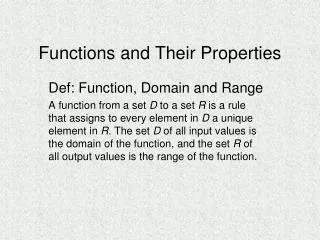
Functions and Their Properties Def: Function, Domain and Range A function from a set D to a set R is a rule that assigns to every element in D a unique element in R. The set D of all input values is the domain of the function, and the set R of all output values is the range of the function.
Function A function from a set D to a set R is a rule that assigns a unique element in R to each element In this definition, D is the domain of the function and R is a set containing the range in D. .
Ways to test for a function • Vertical line test • Ordered pairs (if an x value is repeated) • Finding specific domains
Identifying Domain and Range of a Function • What is Domain? • What is Range? • Find the Domain and Range of f(x) =
Even and Odd Functions • Even functions • Odd functions
Piecewise-defined functions • Graph
Absolute value Function • The absolute value function is defined piecewise by the formula
Composite Functions • Let f and g be two functions such that the domain of f intersects the range of g. The compositionf of g, denoted f ° g, is defined by the rule • (f ° g) = f ( g (x))). • The domain of f ° g consists of all x-values in the domain of g that map to g(x)-values in the domain of f.