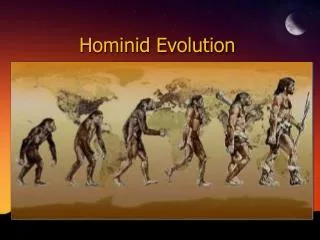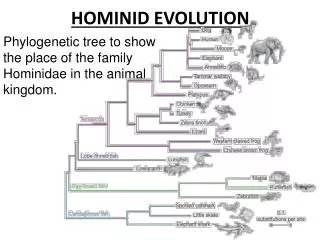

Hominid Evolution
E N D
Presentation Transcript
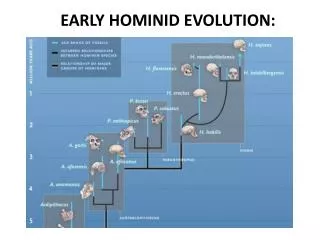
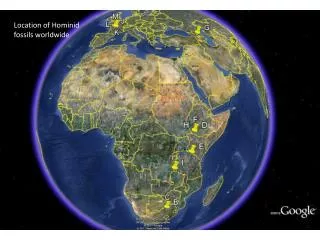
When? Where? • Evolution Timeline
Trends • Bipedalism • African genesis • Savannas? • Environmental variability? • factors favoring bipedalism • modifications for bipedalism • costs of bipedalism
Hominid Trends (cont.) • Expansion of Brain • early hominids = small brains • factors contributing to expansion • Other Trends • reduction of face / teeth / jaws • wider female pelvis • longer infant dependency • division of labor
Australopithecines • Fossil Finds • plentiful sites (Africa) • indicate bipedalism
Australopithecines (cont.) • Adaptations of Australopithecines • dentition • habitation • sexual dimorphism • brain size increasing • habitual bipedalism • use of tools
Homo habilis • Introduction • appeared 2.5 mya • stone tools • traits • larger brain size • elaboration of culture • elaboration of tools • dentition
Homo habilis (cont.) • Cultural Characteristics of Homo habilis • Oldowan pebble tools • unifacial & bifacial • percussion flaking • increased consumption of meat • exploited wide range of animals • mobile populations
Homo erectus • Introduction • widely distributed species • Early Discoveries • “Java Man” • Eugene Dubois – 1891 • Thought to have Asian origin • Other finds • 1950’s – Africa • Indicated earliest presence was African continent
Homo erectus (cont.) • Physical Traits of Homo erectus • increasing brain size • thick skull • face reducing • molars reduced
Homo erectus (cont.) • Acheulian Tool Tradition • St. Acheul, France - first discovery • comparison to Oldowan tools • more elaborate • tools for butchering
Homo erectus (cont.) • Control of Fire • Zhoukoudian Cave, China • Uses of fire • Campsites • near water sites • caves and open areas • base camps? specialized camps? • Terra Amata- near Nice, France
Transition from Homo erectus • areas of agreement • areas of disagreement • fossils with mixed traits • Africa / Europe / Asia • fossils < 200,000 years old • definitely Homo sapiens
Two Origin Theories • Single-origin theory (hatrack) • modern humans evolved in one place • spread rapidly to other areas • superseded Neanderthals • DNA evidence • “Eve” hypothesis • Out-of-Africa
Two Origin Theories (cont.) • Multiregional theory (candelabra) • modern humans evolved in various parts of the Old World • evolved from widely dispersed H. erectus populations • resulted in wide varieties of humans we observe today
Two Origin Theories (cont.) • Multiregional theory (cont.) • Neanderthals were “transitional” form