
SlideServe
Menu
Préférences
© SlideServe · v2026

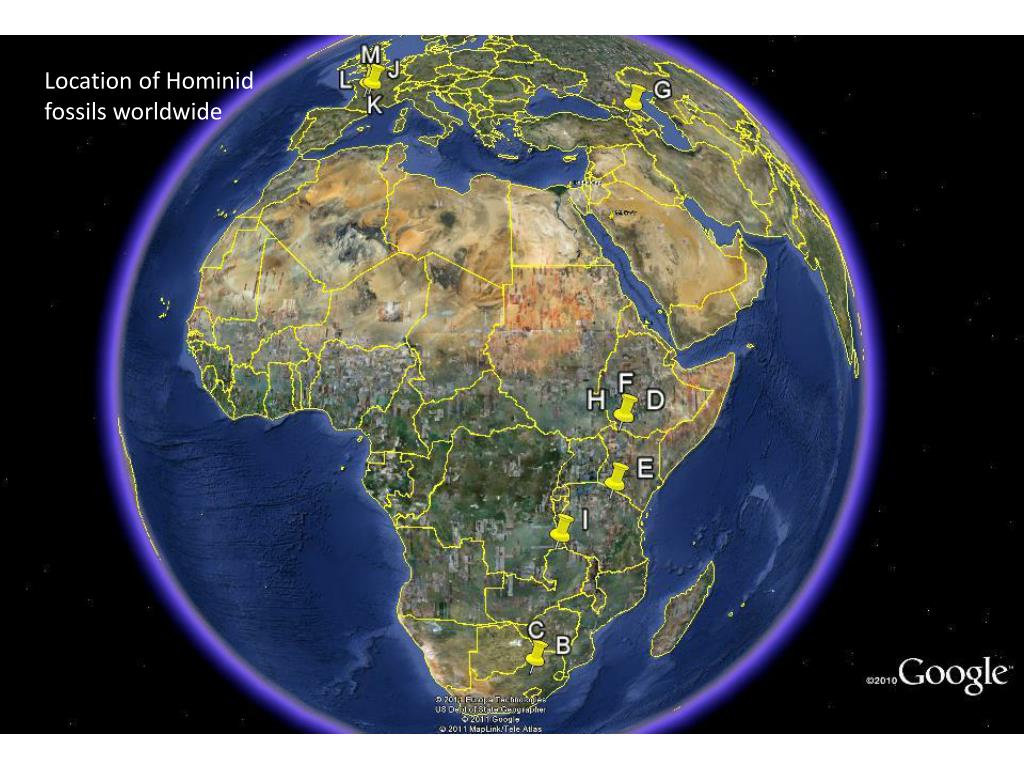
Location of Hominid fossils worldwide

roy avatar
9 diapositives · 244 Views · Aug 10, 2014

The geographical distribution of hominid fossils provides critical insights into the evolutionary history of these early humans and other animals. The locations where these fossils are found can vary significantly from their current positions due to geological factors such as continental drift, pole shifts, and climate changes. Understanding the biological species concept, which emphasizes interbreeding and reproductive isolation, is essential for interpreting these fossils. Fossilization processes, including mineralization and trace evidence, help reveal the complexity of life forms that existed in the past, contributing to our comprehension of species variation and speciation.
Location of Hominid fossils worldwide - slide 1
01 / 9Location of Hominid fossils worldwide
1 / 17

Télécharger la présentation

Location of Hominid fossils worldwide
Une image / un lien ci-dessous est fourni (tel quel) pour télécharger la présentation

Politique de téléchargement : le contenu du site vous est fourni TEL QUEL pour votre information et votre usage personnel ; il ne peut être vendu, concédé sous licence ni partagé sur d’autres sites sans l’accord de son auteur.Le contenu vous est fourni TEL QUEL, pour votre information et votre usage personnel uniquement. Téléchargez la présentation en cliquant sur ce lien. Lors du téléchargement, si vous ne parvenez pas à télécharger une présentation, l’éditeur a peut-être supprimé le fichier de son serveur.Pendant le téléchargement, si vous ne parvenez pas à obtenir une présentation, le fichier a peut-être été supprimé par l’éditeur.

F I N

Plus de contenu associé

Transcription de la présentation
  1. Location of Hominid fossils worldwide

  2. The areas of the world hominids and other animals are found In today may sometimes be vastly different than in the past due to continental drift, pole shifts, and global warming/cooling. These environmental factors play a key role in evolution….

  3. Early Vertebrate Evolution

  4. Definition of Species The biological species concept emphasizes interbreeding and reproductive isolation Depiction of species as groups of individuals capable of interbreeding, but reproductively isolated from other such groups.

  5. species This is a Cladogram

  6. hybrids

  7. Speciation Process by which a new species evolves from a prior species. Speciation is the most basic process in macroevolution.

  8. Fossils Many remains of the hominid species are found in the form of Fossils These are traces of ancient organisms and formed in several ways Mineralization occurs very slowly as water carrying minerals, such as silica or iron, seeps into the tiny spaces within a bone. In some cases, the original minerals within the bone or tooth can be completely replaced. Traces of life forms that include insects trapped in tree sap, leaf imprints, footprints, skeletal remains and remains of digestive tracts

  9. Interpreting Species and Other Groups in the Fossil Record • The goal is to make meaningful biological statements about the variation represented in groups of organisms. • Identifying individual variation, age changes, variation due to sex (sexual dimorphism) • Fossil species are understood based on observations of living animals • In living animals, we can look for variation both among and between species to try and explain fossils…