Equilibrium Analysis for Mechanical Structures
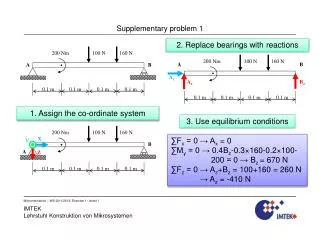
Solve complex engineering problems using equilibrium conditions, calculations, and force diagrams. Learn to replace bearings with reactions and assign coordinate systems.

Equilibrium Analysis for Mechanical Structures
E N D
Presentation Transcript
A B A B B A 200 Nm 200 Nm 200 Nm 100 N 100 N 100 N 160 N 160 N 160 N 0.1 m 0.1 m 0.1 m 0.1 m 0.1 m 0.1 m 0.1 m 0.1 m 0.1 m 0.1 m 0.1 m 0.1 m Supplementary problem 1 2. Replace bearings with reactions Ax Az Bz 1. Assign the co-ordinate system 3. Use equilibrium conditions ∑Fx = 0 → Ax = 0 ∑My = 0 → 0.4Bz-0.3×160-0.2×100- 200 = 0 → Bz= 670 N ∑Fz = 0 → Az+Bz = 100+160 = 260 N → Az = -410 N X Y Z
B B A A A B B A 50 N 50 N 50 N 1 1 4 4 4 40 N 1 1 3 3 3 3 m 3 m 9 m 9 m 3 m 3 m 9 m 9 m Supplementary problem 2 1 3 X Y Z 4. Resolve forces along X and Y directions 2 Ax Ax Bz Bx Az Az Bxz 30 N
B A 40 N 3 m 9 m Supplementary problem 2 5. Use equilibrium conditions Ax Bz • ∑Fx = 0 → Ax-Bx-30 = 0 • ∑My = 0 → 3×40-12Bz = 0 → Bz= 10 N • ∑Fz = 0 → Az+Bz = 40 N → Az = 30 N • Bx = Bz→ Bx= 10 N → Ax = 40 N Bx Az 30 N
p p p A B C B C A B C A a a a l/2 l/2 l/2 l/2 l/2 l/2 Supplementary problem 3 1 3 X Y Z 2 Cx Ax Az Cz
p C A B a l/2 l/2 Supplementary problem 3 4. Make free body diagrams Bz Bx Cx CMy Ax Bx B Az Bz Cz 5 • ∑Fx = 0 → Ax = Bx = Cx • ∑My = 0 → Bz= -p/2 • → Az= p/2 • → CMy= -pa/2 • ∑Fz = 0 → Bz+Cz = 0 → Cz = p/2
10 kN/m 10 kN/m 10 kN/m 2 m 2 m B B A A 3 m 3 m Supplementary problem 4 15 kN Ax Bz • Equivalent force generated by line load = area under the force distribution curve • Line of action – through centroid of the force distribution curve Az 3×2/3 m • Bz = 6 kN, Az = 9 kN, Ax = 0
Problem 3 1. Movement of axes along body axis X X X X C B Y Y Y Y Z Z Z Z D A
Problem 3 2. Dissection of body in segment CD x C X X B Y Y Q negative area M Z Z L L M F3 c-x Q F2 D A 3. Use equilibrium conditions for the segment and calculate IFVs
4. Repeat for segments BC and AB 5. Draw the diagrams for Q,L and M • Draw the body axis • Draw the IFV distribution • Show the sign of IFV in the diagram • Show the important IFV magnitudes Q + F1 • F1 only