Download
1 / 51
510 likes | 646 Vues
Explore the complexities of population dynamics, including vital concepts such as population density, growth rates, and limiting factors. This guide delves into density-dependent and density-independent factors, and differentiates between K-strategists and R-strategists in reproduction. Learn about critical demographic trends like immigration, emigration, carrying capacity, and the stages of demographic transition. This resource also features practical examples and test questions to enhance comprehension and application of population dynamics in real-world scenarios.

E N D
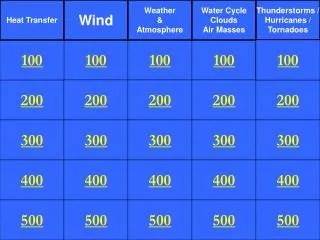
Population Dynamics Limiting Factors Density Problems Human Population Actual Test Questions 100 100 100 100 100 200 200 200 200 200 300 300 300 300 300 400 400 400 400 400 500 500 500 500 500
The type of dispersion displayed by a herd animal such as American Bison.
The type of growth model in which growth begins slow and then increases faster and faster. Shown by a J-Shaped Graph.
The type of growth model in which the population grows slowly at first, followed by a period of rapid growth, and then the stabilizes at the carrying capacity. Shown with an S-Shaped Graph.
Any factor in the environment that depends on the number of members in a population per unit area. (Disease, Competition, Parasites)
Any factor in the environment that does NOT depend on the number of members per unit area. (Weather, Human Influence)
The type of reproductive strategists that produces few offspring and invests a lot of resources into each offspring. (Humans, Elephants)
The type of reproductive strategists that produce many offspring expending little energy to each. (Fruit Flies, Mosquitoes)
The maximum number of individuals in a species that an environment can support for the long term.
A population of bees starts at 100. If the growth rate is an increase of 50 bees/year, how many bees will there be in the population after 5 years?
The study of human population, density, distribution, movement, and birth and death rates.
The number of males and females in each of three age groups: pre-reproductive stage, reproductive stage, and post-reproductive stage.
The largest factor causing an increase in the population of the united states.
A change in a population from high birth and death rates to low birth and death rates.
The size of a population will decrease if mortality _________.
Density, distribution, and growth rate are characteristics used to classify which one of the following? A. BiomesB. PopulationsC. Limiting FactorsD. Age Structure
A flowering plant has seeds that are carried by the wind. Infer the most likely dispersion pattern of the plants that grow from these seeds.A. UniformB. Clumped GroupsC. RandomD. Spatial
The human population growth rate has always increased. (True or False)
A fruit fly that has a short life span and produces many offspring can be classified into which reproductive strategy?A. r-strategistB. k-strategistC. a carrying-capacity strategistD. a logistic strategist