Function of Muscles
60 likes | 208 Vues
The muscular system plays a crucial role in allowing the body to move, maintain posture, communicate, and perform vital functions such as breathing and digesting food. It consists of three main types of muscles: skeletal, cardiac, and smooth. Skeletal muscles are striated, voluntary, and attach to bones, while smooth muscles are non-striated and involuntary, found in hollow organs. Cardiac muscles, found only in the heart, are striated and involuntary. Understanding these characteristics helps us appreciate the complexity and importance of muscles in everyday life.


Function of Muscles
E N D
Presentation Transcript
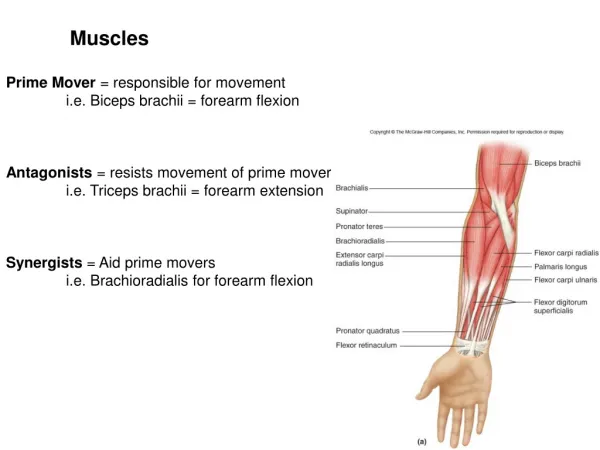
Function of Muscles • Produce movement • Maintain posture • Communication: speak, write, read, etc. • Breathing • Moving food through digestive tract • Pumping blood through body • Eliminating waste • Stabilize joints • Generate heat
Characteristics of Muscles • Muscle cells are elongated (muscle cell = muscle fiber) • Contraction of muscles is due to the movement of microfilaments • All muscles share some terminology • Prefix myo refers to muscle • Prefix mys refers to muscle • Prefix sarco refers to flesh
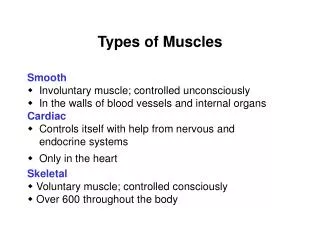
The Muscular System • Muscles are responsible for all types of body movement • Three basic muscle types are found in the body • Skeletal muscle • Cardiac muscle • Smooth muscle
Skeletal Muscle Characteristics • Most are attached by tendons to bones • Cells are multinucleate • Striated – have visible banding • Voluntary – subject to conscious control • Cells are surrounded and bundled by connective tissue
Smooth Muscle Characteristics • Has no striations • Spindle-shaped cells • Single nucleus • Involuntary – no conscious control • Found mainly in the walls of hollow organs Figure 6.2a
Cardiac Muscle Characteristics • Has striations • Usually has a single nucleus • Joined to another muscle cell at an intercalated disc • Involuntary • Found only in the heart Figure 6.2b