6.2 Exponential Functions Notes
This comprehensive guide delves into the fundamentals of exponential functions, distinguishing them from linear and quadratic equations. We'll explore the characteristics of exponential growth and decay, including their graphical representations based on their base and exponent values. Learn how to calculate compound interest and the impact of different compounding frequencies (annually, semiannually, quarterly, monthly, and daily) on investments. A step-by-step example illustrates calculating the final amount of an investment at 5% interest over ten years, using various compounding periods.

6.2 Exponential Functions Notes
E N D
Presentation Transcript
6.2 Exponential FunctionsNotes Linear, Quadratic, or Exponential? Exponential Growth or Decay? Match Graphs Calculate compound Interest
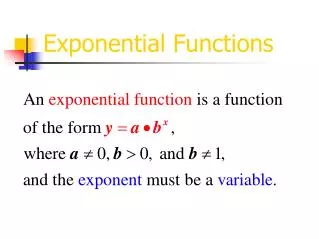
Linear, Quadratic, or Exponential? • Linear looks like: • y = mx+b • Quadratic looks like: • y = ax2+bx+c • Exponential looks like: y = a•bx exponent y = a•bx coefficient base
Examples: • f(x) = (77 – x)x • g(x) = 0.5x – 3.5 • h(x) = 0.5x2 + 7.5
Growth or Decay? • Growth if: • base>1 and • exponent is positive • Decay if: • base<1 or • exponent is negative • Growth if (unusual case): • base<1 and exponent is negative
Examples: • f(x) = 500(1.5)x • d(x) = 0.125(½)x • s(k) = 0.5(0.5)k • f(k) = 722-k
Growth looks like: Base is smaller. Base is larger.
Decay looks like: Base is smaller. Base is larger.
Compound Interest • A = amount after t years • P = principal (original money) • r = interest rate • n = number of compounds per year • t = time in years
Vocabulary • annually = 1 time per year • semiannually = 2 times per year • quarterly = 4 times per year • monthly = 12 times per year • daily = 365 times per year
Example • Find the final amount of a $100 investment after 10 years at 5% interest compounded annually, quarterly, and daily. • P = 100, t = 10, r = .05, n = 1, 4, 365 (3 calcs)
Example, part 2 • Find the final amount of a $100 investment after 10 years at 5% interest compounded annually, quarterly, and daily. • P = 100, t = 10, r = .05, n = 1, 4, 365 (3 calcs)
Example, part 3 • Find the final amount of a $100 investment after 10 years at 5% interest compounded annually, quarterly, and daily. • P = 100, t = 10, r = .05, n = 1, 4, 365 (3 calcs)