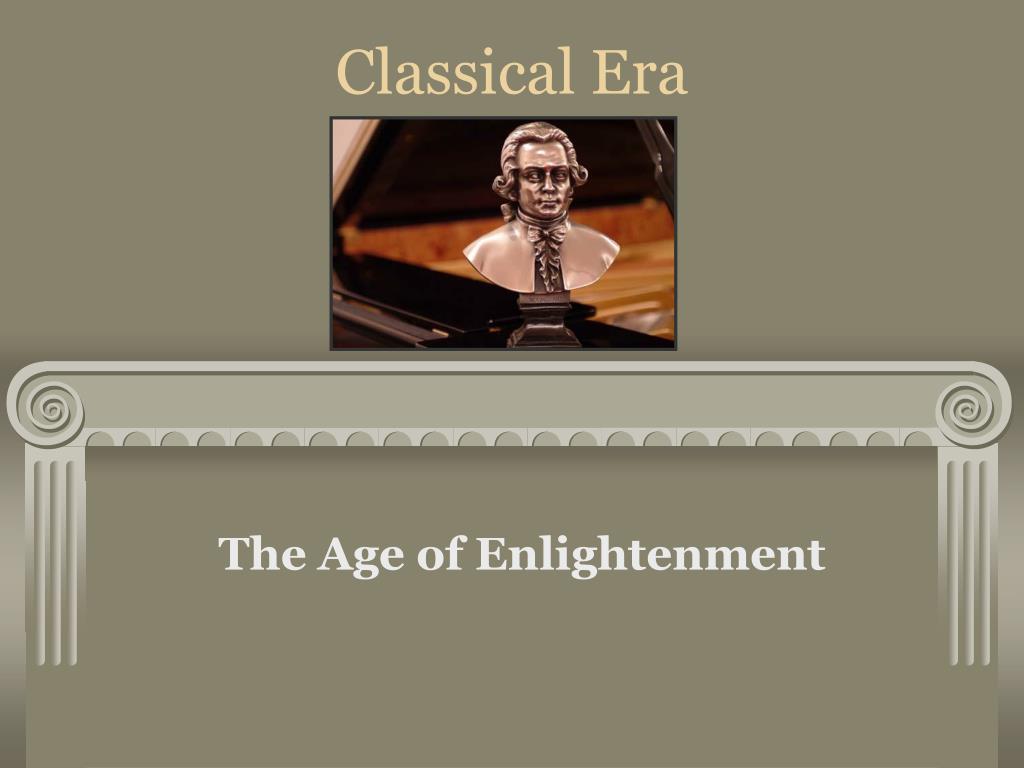
Classical Era. The Age of Enlightenment. Baroque Era Louis XIV, XV Frederick the Great Catherine the Great POWER WEALTH. Classical Era French and American Revolutions Middle class becomes more influential “The first law is to enjoy oneself.”. Things are a-changin’. The Enlightenment.
Une image / un lien ci-dessous est fourni (tel quel) pour télécharger la présentation
Politique de téléchargement : le contenu du site vous est fourni TEL QUEL pour votre information et votre usage personnel ; il ne peut être vendu, concédé sous licence ni partagé sur d’autres sites sans l’accord de son auteur.Le contenu vous est fourni TEL QUEL, pour votre information et votre usage personnel uniquement.Téléchargez la présentation en cliquant sur ce lien.Lors du téléchargement, si vous ne parvenez pas à télécharger une présentation, l’éditeur a peut-être supprimé le fichier de son serveur.Pendant le téléchargement, si vous ne parvenez pas à obtenir une présentation, le fichier a peut-être été supprimé par l’éditeur.
Baroque Era Louis XIV, XV Frederick the Great Catherine the Great POWER WEALTH Classical Era French and American Revolutions Middle class becomes more influential “The first law is to enjoy oneself.” Things are a-changin’
The Enlightenment • What’s IN? • rational, logical, empirical, reasoned • What’s OUT? • Status quo, supernatural (What comes into question?) • The “brotherhood of man” becomes a popular theme, and Freemasonry grows. Both of these are, to some degree, at odds with the principals of enlightenment thinking. • Contradiction, inconsistency, paradox = quite acceptable, almost the norm.
The Classical Era • “Classical,” “classic,” “classicism”= very broad terms; not particularly well suited to describe this time in history. Interest in clean, simple lines of classical Greek architecture may provide connection. • Approximately the 18th Century
Classicism Defined • The period of the ancient Greeks and Romans • A standard (enduring) • Genre of music • Time period 1750-1820
The Classical Era • Cultural, societal adolescence--much change (often violent) & growth • Industrial revolution: • move from agrarian to industrial economy • migration from country to cities • huge cities--e.g., 1800 Vienna = 250,000!! • American and French Revolutions: • Europe in turmoil caused by Napoleon’s expansionism after French Revolution • redefine relationship of government and people
The Classical Era • How is the relationship of government/aristocracy and common people redefined? • IndIvIdual becomes central. Government exists to serve ME;Ido not exist to serve government (and, no, I will NOT eat cake...). • The American and French Revolutions illustrate the point.
The Rise of the Middle Class • a VIMP sociological process • industrialization produces more money for lower classes • eventually more “wealth” produces more leisure time • more leisure time leads to search for entertainment that produces . . . . . . . . . . . . . . . • fundamental changes in the arts: • music functions mostly as Entertainment (not worship as in Baroque era)
Classical Thinking • Reason was supreme • Sought the perfect society • Enlightenment • Beauty • Rules were valuable
Rococo • Emphasis on ultra beauty and nature • Less dramatic (more sweet) than Baroque • Themes: aimed at the wealthy class • Lighter, frivolous • Picnics, lovers, Greek gods • Portraits
Art in the 18th Century • Baroque had been the style from 1600 to 1750 • Elaborate, impressive • Show glory of church and/or state • New direction was disputed Baroque Classical (Simpler) Rococo (Sweeter, nature)
Date data Caravaggio, The Calling of St Matthew; Baroque beginnings 1600 – 1742 – Handel’s Messiah oratorio 1776 – Amer. Rev. 1787 – J.L. DavidDeath of Socrates(Mozart, Don Giovanni) 1789 – French Rev.
The Enlightenment • Application of the scientific method to social problems • Parallel to the scientific awakening • Foundation of Classical art and music • The world behaves according to patterns and these ought to be obeyed
Basic Premises • Scientific method can answer fundamental questions about society • Human race can be educated and all people are important • Emergence of the middle class • Belief in God based on reason
Growth of Deism • Intellectuals believe in God but see him as a "watchmaker" • Deists skeptical of organized religion • Catholic church was attacked • Deists struggle with personal standards • Denial of providence (Voltaire) disputed by others (Pope, Rousseau) • Denial of evil
Thomas Hobbes • Empiricism "All that is real is material, and what is not material is not real." – Hobbes
Thomas Hobbes • Government "[Early man was] solitary, poor, nasty, brutish, and short... [and in a constant state of] warre, [living in] continual fear and danger of violent death.“ – Leviathan • Absolute monarchy sent by God to help mankind • Hobbes' concepts used to justify colonialization
John Locke • The forefather of our forefathers • Attacked by Charles II • Friend of Newton • Influential in American revolution
John Locke • Government • Second treatise of Civil Government • Chaos without government • God gave mankind natural rights • Life, liberty, pursuit of property • Innate goodness of mankind led to formation of governments • Governments, which were formed by the people, must guarantee the rights of the people • People have a right to rebel against tyrannies
John Locke • Theory of Knowledge • Essay Concerning Human Understanding • Reasoning puts man above animals • Rejected concept that ideas are innate • Outer ideas from experience • Inner ideas from contemplation • Mankind can attain all knowledge
Alexander Pope • English Poet • Contributed to political thought and love of language • Believed that God was in control of the earth and that all things were ultimately for our good • Essay on Man • Essay on Criticism • Many famous sayings came from these books
Philosophe • French name for philosopher • Enlightenment reached height in France
Voltaire • Pen name • Critical of Catholic church • Influenced others by letters • Denied writings to avoid problems • Exiled to England for a while • Returned to live on Swiss border
Jean-Jacques Rousseau • Contest: "Does progress in the arts and sciences correspond with progress in morality?" • No! • As civilizations progress, they move away from morality • Examples: Romans, Greeks, Egyptians • Civilization itself leads away from true fundamentals • Technology and art give false desires • Social Contract • “Noble Savage”
Jean-Jacques Rousseau • Influence on French and American revolutions • "Liberty, Equality, Fraternity" • Invest all rights and liberties into a society • Compare to a corporation
Denis Diderot • Encyclopedia • Teach people how to think critically • Solicited articles from many experts • Controversial articles brought criticism • Overall, moved forward the ideas of Enlightenment
"The good of the people must be the great purpose of government. By the laws of nature and of reason, the governors are invested with power to that end. And the greatest good of the people is liberty. It is to the state what health is to the individual." - Diderot in L'Encyclopedie: Article on Government, quoted in Barzun, Jacques, From Dawn to Decadence, Perennial, 2000, p370.
Immanuel Kant • From Germany • Strict habits • The Critique of Pure Reason and …Practical Reason • Weakness of Empiricism • Transcendentalism • Empiricism and other knowledge • Ex: infinity • Categorical Imperative
"You should behave with only those types of behavior that are dictated by the absolute nature of the basic principle on which the act is based." "Act as if your actions would become a moral maxim (principle or model) for all others and at all times." – From Immanuel Kant's Categorical Imperative
David Hume • Scottish philosopher • Leader of empiricism movement • Grew to distrust all
Adam Smith • Scottish professor • Wealth of Nation (1776) Free trade/capitalism • Devised capitalism • Laissez Faire la nature Literally, "let do": a philosophy that advocates minimal government interference in the economy.
Connexion au compte
Connectez-vous pour publier votre contenu sur SlideServe.