Exploring Atomic Structure, Bonding, and Water Properties
This comprehensive overview covers essential concepts in atomic structure, including subatomic particles like protons and electrons, and their roles in defining chemical properties. The text explains different types of bonds such as covalent and ionic bonds, and introduces isotopes and compounds. It also delves into unique properties of water, including its polarity, hydrogen bonding, and pH levels. Fundamental concepts such as acids, bases, and buffers are addressed, making it an informative resource for understanding chemistry fundamentals.

Exploring Atomic Structure, Bonding, and Water Properties
E N D
Presentation Transcript
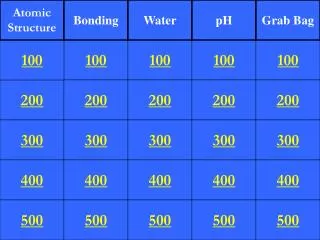
Atomic Structure Bonding Water pH Grab Bag 100 100 100 100 100 200 200 200 200 200 300 300 300 300 300 400 400 400 400 400 500 500 500 500 500
This subatomic particle controls an elements physical properties
This is the name for an element that has added or lost a neutron.
The charge of an atom that has 114 protons and 117 electrons.
A pure substance, formed by the chemical combination of two or more elements in definite proportions
The names of three chemical compounds, and their chemical formulae
The type of attraction (relatively weak) between oppositely charged molecules
This is the molecular property that makes water have so many special qualities
Because of their oppositely charged ends, water molecules stick to each other due to this type of bond
The phenomenon that occurs when molecules of different substances attract to each other
Demo Daily Double The effect that makes this happen
The type of substance that contain high concentrations of H+ ions
The formula for the breakdown of water into its two ion constituents
The last element that can be forged in a star before it blows up in a nova