
SlideServe
Menu
Préférences
© SlideServe · v2026

The Phylum Arthropoda: Fascinating Facts about Crustaceans and Insects

said avatar
5 diapositives · 279 Views · Feb 02, 2014

The intriguing world of Phylum Arthropoda, which includes butterflies, spiders, shrimp, crabs, and lobsters. This diverse phylum is characterized by jointed feet, bilateral symmetry, and segmented bodies. Arthropods possess a complete digestive system, breathe via gills, and have complex nervous systems. They boast over 1,000,000 species, making them the most successful animal phylum on Earth. Learn about their exoskeletons, specialized appendages, and various classes, including Insecta and Crustacea, which encompass a wide array of marine life like crabs and lobsters.
The Phylum Arthropoda: Fascinating Facts about Crustaceans and Insects - slide 1
01 / 5The Phylum Arthropoda: Fascinating Facts about Crustaceans and Insects
1 / 17

Télécharger la présentation

The Phylum Arthropoda: Fascinating Facts about Crustaceans and Insects
Une image / un lien ci-dessous est fourni (tel quel) pour télécharger la présentation

Politique de téléchargement : le contenu du site vous est fourni TEL QUEL pour votre information et votre usage personnel ; il ne peut être vendu, concédé sous licence ni partagé sur d’autres sites sans l’accord de son auteur.Le contenu vous est fourni TEL QUEL, pour votre information et votre usage personnel uniquement. Téléchargez la présentation en cliquant sur ce lien. Lors du téléchargement, si vous ne parvenez pas à télécharger une présentation, l’éditeur a peut-être supprimé le fichier de son serveur.Pendant le téléchargement, si vous ne parvenez pas à obtenir une présentation, le fichier a peut-être été supprimé par l’éditeur.

F I N

Plus de contenu associé

Transcription de la présentation
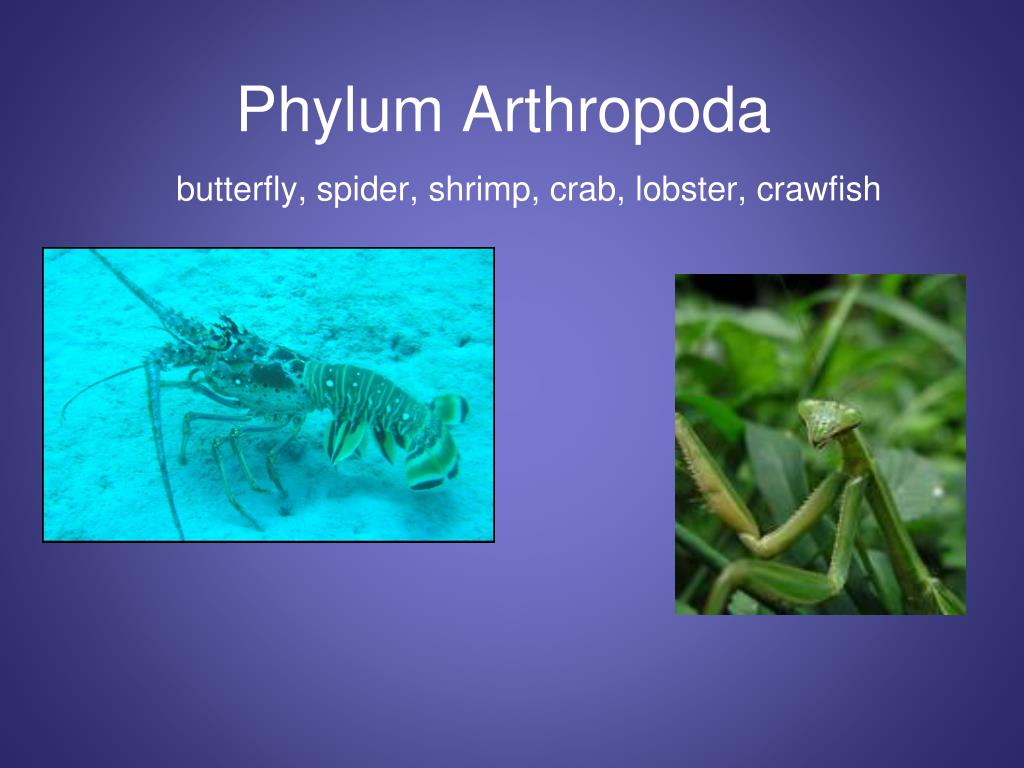
  1. Phylum Arthropoda butterfly, spider, shrimp, crab, lobster, crawfish

  2. Characteristics • “jointed feet” • specialized for sensing, eating, reproducing, moving and defending. • bilateral symmetry • segmented bodies (16-20 segments) fused into larger body regions. • complete digestive system • closed circulatory system • Breathe via gills • Brain, nerve cords and ganglia • 1,000,000 species (includes insects) • Most successful of earth’s animal phylum for 3 reasons; 1. exoskeleton – lightweight, strong, form fitted; made of chitin; is a hard covering on the outside of body which provides both support and protection 2. striated muscle – quick, strong, capable of rapid movement 3. articulation – ability to bend at joints (no ball-in-socket but each joint along an appendage moves in a different plane) • Molting – required for an arthropod to grow; shedding of old exoskeleton • Class Insecta - largest class of arthropods with only one marine genius • Class Crustacea - includes 30,000 species of primarily marine gill breathers • Appendages are specialized for sensing, food handling, fighting and walking

  3. Class Crustacea • crawfish, lobsters, and crabs • Crustaceans have legs with claws, chewing mouthparts, two pair of antennae, and two body segments. • Order Decapoda (crabs) • “10 feet” • All marine • All benthic

  4. Order Decapoda • Structures • Cheliped- the front leg with the claws • Arm Segments –bendable parts of the arm • Manus – similar to the palm of the hand • Dactyl- the moveable finger • Walking legs – decapods have 5 pairs (including the cheliped) • Antennae- used to sense the environment, touch and chemicals • Eyes- located on stalks • Carapace-smooth covering it covers the head and thorax • Abdomen- underside of the exoskeleton, a small piece shows from the top view • Swimming leg-found on certain crabs it has a paddle-foot

  5. Types of Crabs • Cancer crab – found in intertidal cold and temperate waters, it uses its cheliped to crush snail and bivalve shells • Shore crab- found in the rocky intertidal zone. Some are herbivores and used their cheliped to cut algae off rocks and eat it • Blue crab – Found in the Atlantic Ocean and the Gulf of Mexico. It has a swimming leg. They are carnivores and prefer to be predators, burying themselves in the sand with only their eyes showing until a fish swims overhead when they try to grab it with their claws. • Box crab – also called the rooster crab, it uses its cheliped like a can opener on snails