Download

1 / 11
110 likes | 229 Vues
This guide explores the essential features of first declension nouns in Latin, focusing on the five major cases: nominative, genitive, dative, accusative, and ablative. Each case serves a unique function in a sentence; for instance, the nominative case identifies subjects, while the genitive case indicates possession. Examples illustrate how to use the noun "puella" (girl) in various contexts. This resource is invaluable for students of Latin looking to comprehend noun cases and their grammatical roles.

E N D
First Declension Nouns 6 September 2006
Case • A characteristic of Latin nouns is case. • Case indicates the role of the noun in a sentence. • There are five major cases: • Nominative • Genitive • Dative • Accusative • Ablative
Nominative Case • Used for subjects • Used for predicate nominatives
Genitive Case • for possession (the possessor—rather than what is possessed—is in the genitive case • For other grammatical constructs that can be translated with “of,” e.g., “one of you,” “book of Lucy” or “Lucy’s book”
Dative Case • Used chiefly for indirect objects • I sent my friend a letter. • You showed me the book. • She gave the customer a receipt. • He told the students about the author.
Accusative Case • Used for direct objects • Used for the objects of certain prepositions
Ablative Case • Used for the objects of certain prepositions
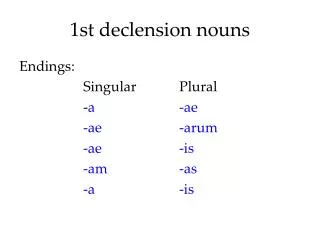
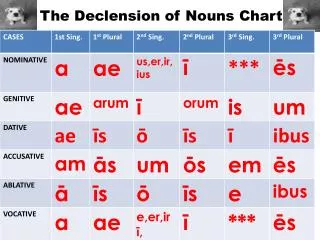
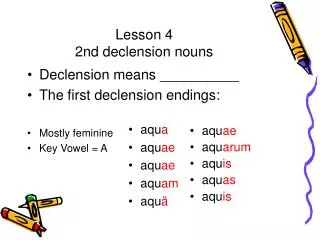
1st Declension Nouns sg. plural • N. –a –ae • G. –ae –ārum • D. –ae –īs • Acc. –am –ās • Abl. –ā –īs
Finding the stem • Take the genitive of the noun and subtract the genitive ending. EXAMPLE: PUELLAE-AE=PUELL
Ex: Fēmina videt stellās et lūnam. Fēmina nom. sg. woman videt 3d sg. videō, vidēre sees stellās acc. pl. stella, stella, f. stars et conj. and lūnam acc. sg. lūna, lūnae, f. moon The woman sees the stars and moon.