Understanding the Articles of Confederation: Structure, Powers, and Limitations
100 likes | 226 Vues
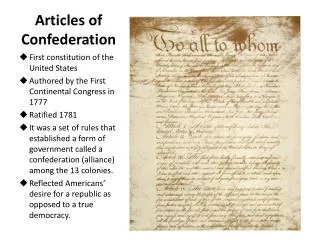
The Articles of Confederation, drafted by John Dickinson in 1777 and ratified in 1781, served as the first constitution of the United States. They established a weak central government with no executive or national court system, leading to significant limitations on Congress, including the inability to levy taxes or regulate trade. While the Congress could declare war, raise armies, and manage foreign treaties, it often struggled to exert authority, resulting in a "toothless tiger" that failed to unify the states effectively. The Northwest Ordinance eventually helped address land disputes.


Understanding the Articles of Confederation: Structure, Powers, and Limitations
E N D
Presentation Transcript
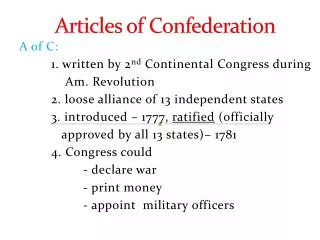
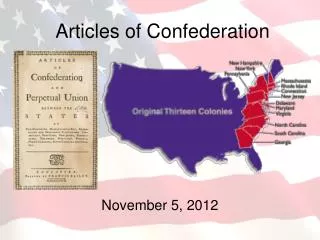
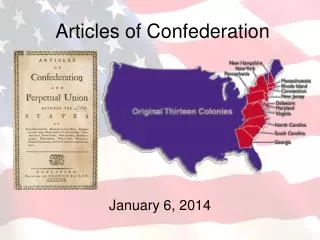
Articles of Confederation • A. A.O.C. drafted 1777 • 1. John Dickinson- author • 2. Ratified 1781
3. Land disputes kept it from being ratified • 4. North West Ordinance- ends disputes
B. Organization of A.O.C. • 1. No chief executive • 2. No national Court system • 3. All power reserved to the states
C. Powers of Congress • 1. Declare war & make peace • 2. Raise army & navy • 3. Treaties & foreign alliances
4. Coin & borrow money • 5. Regulate weights & measures
6. Establish post office • 7. Regulate Indian Affairs
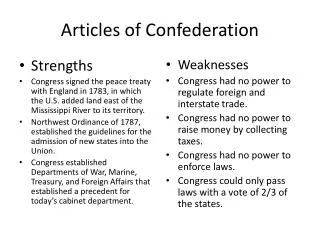
D. Powers denied Congress • 1. Power to levy taxes • 2. Regulate foreign & domestic trade • 3. Settle disputes between states
4. Collect state debts to Congress • 5. Enforce any of its powers
In reality, the A.O.C. had no power. • It was all bark and no bite. • It was a toothless tiger.