AP Language and Composition Vocabulary Week One
40 likes | 186 Vues
This week, we delve into key vocabulary that is crucial for mastering AP Language and Composition. Explore terms like "abjure," meaning to renounce, and "anomaly," which refers to deviations from the norm. Learn about "equanimity," the state of calmness, and "estrange," which means to alienate. Understand descriptors such as "florid," indicating rosy colors, and "lugubrious," denoting gloominess. Additional terms include "propitious," "ubiquitous," and "zealous." Enhance your vocabulary with definitions, synonyms, and antonyms to elevate your writing skills.


AP Language and Composition Vocabulary Week One
E N D
Presentation Transcript
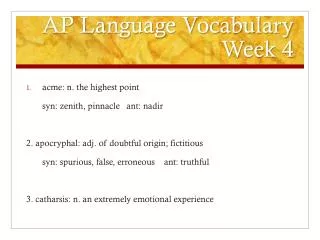
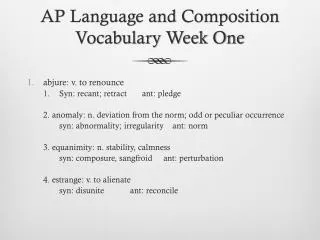
AP Language and Composition Vocabulary Week One • abjure: v. to renounce • Syn: recant; retract ant: pledge 2. anomaly: n. deviation from the norm; odd or peculiar occurrence syn: abnormality; irregularity ant: norm 3. equanimity: n. stability, calmness syn: composure, sangfroid ant: perturbation 4. estrange: v. to alienate syn: disunite ant: reconcile
5. flay: v. to whip; to remove skin syn: skin 6. florid: adj. rosy-colored, reddish syn: ruddy ant: pale, wan 7. interminable: adj. tiresome and long syn: unending, continuing 8. lugubrious: adj. mournful, gloomy syn: sorrowful ant: joyful
9. nondescript: adj. having no individuality syn: amorphous ant: unusual 10. propitious: adj. favorable; auspicious syn: promising ant: adverse 11. rife: adj. abundant, prevalent syn: dominant, full ant: scarce, rare 12. truncate: v. to shorten syn: abridged, abbreviated ant: lengthened
13. ubiquitous: adj. occurring everywhere; omnipresent syn: universal 14. vernacular: n. everyday language syn: dialect 15. zealous: adj. fervent; fanatical syn: passionate, enthusiastic ant: apathetic