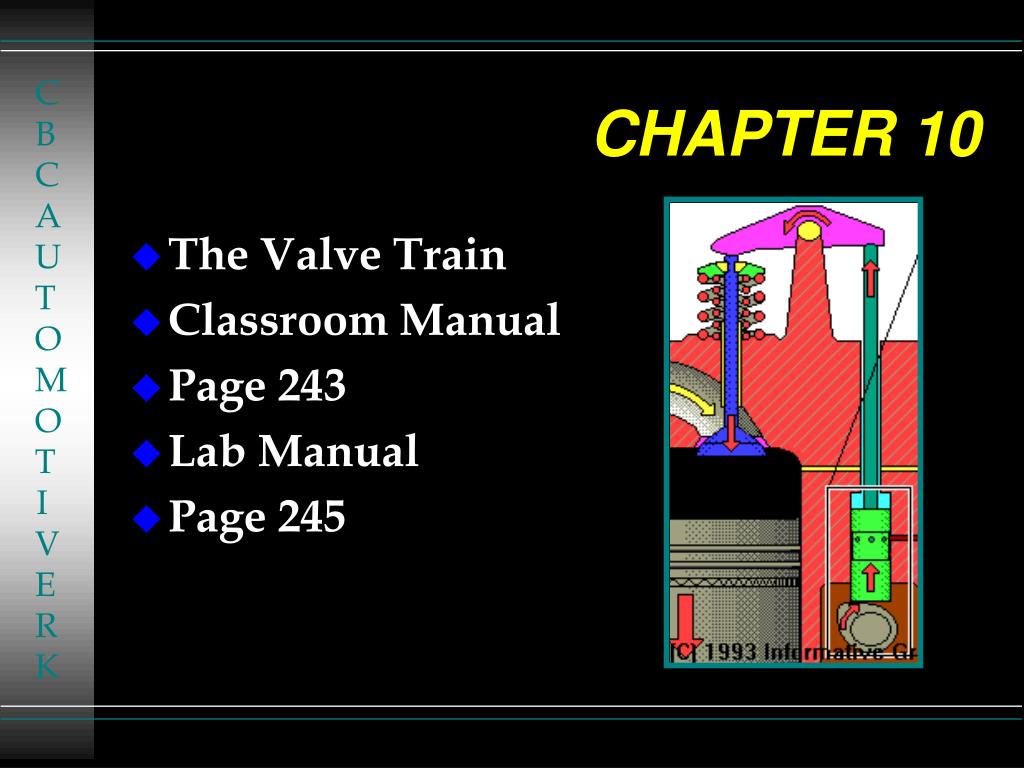
CBC AUTOMOTIVE RK CHAPTER 10 • The Valve Train • Classroom Manual • Page 243 • Lab Manual • Page 245
CBC AUTOMOTIVE RK CHAPTER OBJECTIVES • Explain the function of the valve train. • Describe the automatic belt tensioners. • List the components of the valve train. • Explain the purpose & function of the camshaft. • Describe the relationship between the camshaft lobe design and lift, duration and overlap.
CBC AUTOMOTIVE RK CHAPTER OBJECTIVES • Properly degree a camshaft. • Explain the purpose of lifters. • Describe the operation of hydraulic lifters. • Inspect the pushrods & DNR. • Describe the methods used to correct rocker arms, and rocker arm geometry.
CBC AUTOMOTIVE RK CHAPTER INTRODUCTION • Internal combustion engine is a AIR PUMP. • MORE AIR - MORE POWER. • Cam grind determines Performance. • Cam grind determines driveability characteristics. • Cam Drives Page 243
CBC AUTOMOTIVE RK CAM DRIVES • The Camshaft is Driven by the Crankshaft. • Cam is driven at one half Crank speed. • Cam Gear has twice as many teeth as crank gear. Page 244 Class
CBC AUTOMOTIVE RK CAM DRIVES • Three types of cam drives. • Timing chain and sprockets. • Some engines use spacers between sprocket and cam. • Gear drives. • Heat Aluminum Gears to aid installation. • Belt and sprockets. Page 244 Class
CBC AUTOMOTIVE RK COMMON CAM DRIVES
CBC AUTOMOTIVE RK GEAR DRIVES • Cam gear is soft - Fiber or Aluminum • Are press fit to cam - Pre-heat to 200 degrees to install. • Crank gear - Steel • Advantages - Less wear and Backlash • Disadvantages - Takes more space and can be noisy. Page 245
CBC AUTOMOTIVE RK SPROCKETS • Used with chains. • Can be made of: • Steel • Iron • Aluminum (Nylon coated teeth) - can stick oil pump relief valve. • Do Not use a worn Sprocket with a New Chain. Page 245
CBC AUTOMOTIVE RK TIMING CHAINS • Roller Chain (bicycle style) • Silent Chain - 2 styles • Small Pin - Stiff • Large Pin - Limp Page 245
CBC AUTOMOTIVE RK TIMING BELTS • Cogged Belt Drive. • Advantages Lighter, Quieter, Easier to Change. • Virtually no stretch in service. • Watch rib tooth shape - Rounded or Square. • Replacement 30,000 to 60,000 miles. Page 245
CBC AUTOMOTIVE RK ECCENTRIC ADJUSTER
CBC AUTOMOTIVE RK TIMING the CAMto the CRANK • Timing marks facing each other. • Timing marks a specified number of links apart. • Timing marks aligned with colored links on the chain. • Timing marks align with marks on head and block. Page 247 Lab
CBC AUTOMOTIVE RK TIMING the CAMto the CRANK • Match old parts to new ones. • Specifically match keyway and timing mark. • Make sure # 1 piston is at TDC when marks are lined up. • Off brands are noted for inaccurate timing marks. Page 248 Lab
CBC AUTOMOTIVE RK CAMSHAFT • Two cam lobes per cylinder • One lobe for the Intake Valve • One for the Exhaust Valve • High Performance Multi-Valve per Cylinder Engines • One lobe per valve 4 on 4 valve per cylinder • Fuel Pump Eccentric cast-in or bolted on • Distributor and Oil Pump Drive Gear
CBC AUTOMOTIVE RK CAM THRUST • Cam Gear provides thrust surface. • Oil pump driven by bottom of distributor shaft. • Lifters also provide thrust. • Timing Chain. • Some Engines have a thrust plate. Lecture
CBC AUTOMOTIVE RK PARTS of a CAM LOBE • Base circle • Lobe or Nose • Opening and Closing Ramps • Opening and Closing Clearance Ramp • Page 194 Figure 8.22 Page 245
CBC AUTOMOTIVE RK PARTS of a CAM LOBE Page 247
CBC AUTOMOTIVE RK CAM MEASUREMENTS • Lift - Valve & Cam - Measured in inches. • Duration - Measured in degrees of crank rotation. • Overlap - Both intake & exhaust valves open. • Split Overlap - Both valves open equally at TDC. • Centerline - Point of maximum opening. Page 248
CBC AUTOMOTIVE RK CAM CARD Page 243
CBC AUTOMOTIVE RK CAM PATTERNS • Single pattern - Intake and Exhaust lobes have same Profile. • Asymmetrical - Intake and Exhaust Profiles are different. Page 248
CBC AUTOMOTIVE RK OVERLAP and CENTERLINE • Lobe spread 105 to 115 degrees. • Advanced cam timing - Intake centerline less than lobe spread. • Advanced cam timing improves low and mid range Torque. • Retarded cam timing - Intake centerline greater than lobe spread. • Retarded cam timing improves high RPM power. Page 248
CBC AUTOMOTIVE RK LOBE SEPARATION ANGLE Page 254 Lab
CBC AUTOMOTIVE RK VALVE LIFTERS • Mechanical • Hydraulic • Flat Tappet • Mushroom • Roller Page 250
CBC AUTOMOTIVE RK LIFTER AND CAM LOBE • Lifter face has Convex Shape. • Cam Lobe has taper of .0007” to .002”. • Lifter must spin to Dissipate Load. • Lifter’s convex shape prevents Edge Loading. Page 249
LIFTER AND CAM LOBE • Cam and Lifters become wear mated in first few minutes. • If cam is replaced replace lifters also. • Used lifters will rapidly wear out a new cam. Page 249
CBC AUTOMOTIVE RK LIFTER AND CAM LOBE • Lubrication and Break-in. • Cam is lubed by crank spray • First 1/2 Hour is Critical. • Must use (EP) Extreme Pressure Lubricant. Page 249
CBC AUTOMOTIVE RK LIFTER AND CAM LOBE • Minimum RPM 1500 for 15 Minutes. • Some OHV have oil passage in cam. • Oil holes on each Lobe, if plugged instant cam failure. • Oil changes are important to cam life. • Page 194 Figure 8.21 Page 249
CBC AUTOMOTIVE RK ROLLER CAM AND LIFTERS • Roller lifters can accept higher lift rate without wear. • Roller lifters reduce valve train friction. • Roller lifters must have a way of keeping them from turning. Page 250
CBC AUTOMOTIVE RK ROLLER CAM AND LIFTERS • Roller Cams are made of steel (not cast iron). • Roller Cams have more aggressive Profiles. • Lobes are polished to a fine matte finish. • After break-in, the lobe has a mirror finish. Page 245
CBC AUTOMOTIVE RK REGRINDING CAMSAND LIFTERS • I do not recommend using reground cams. • I do not recommend using reground lifters. Page 259 Lab
CBC AUTOMOTIVE RK VALVE LASH • Mechanical Camshafts • Hydraulic Camshafts • Clearance Page 263 Lab