
Understanding Invertebrates and Plants: Key Identifications and Classifications
Discover the fascinating world of invertebrates and plants, two major categories of life on Earth. Invertebrates, comprising over 98% of animals, include diverse groups such as arthropods, mollusks, cnidarians, and segmented worms. Learn about their unique characteristics, such as regeneration abilities and symbiotic roles. Explore the plant kingdom, from vascular plants with complex systems for nutrient transport to nonvascular plants like mosses. This guide delves into their classification, reproductive methods, and ecological importance, providing a comprehensive overview of life forms without backbones and the plant varieties that thrive alongside them.

Understanding Invertebrates and Plants: Key Identifications and Classifications
E N D
Presentation Transcript
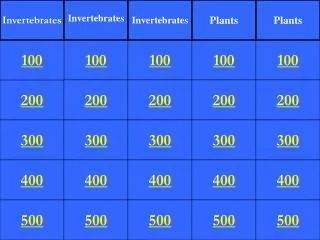
Invertebrates Invertebrates Invertebrates Plants Plants 100 100 100 100 100 200 200 200 200 200 300 300 300 300 300 400 400 400 400 400 500 500 500 500 500
I provide marine plants a place to live and have tubes in which to gather nutrients
Jellyfish, hydras, coral, and sea anemones fall into this phylum
I am a soft-bodied invertebrate that usually (but not always) has a shell
Most of us are beneficial decomposers, but one of us – the trichina- can be found in pork and is harmful
We reproduce by simply dividing into two, creating two new worms
We can attach ourselves to the intestines of a host and deprive them of valuable nutrients
Describing name for organisms that have a nucleus within their cell structure
The two parts of a plant cell not contained in an animal cell
What are the cell wall and chlorophyll/ chloroplasts?
Plants that have tubular system for nutrient and water transport
The names of the tubes that transport nutrients, water, and food







![[PDF]❤️DOWNLOAD⚡️ Hungry Girl: 200 Under 200: 200 Recipes Under 200 Calories](https://cdn7.slideserve.com/13155744/bestseller-dt.jpg)
