Understanding Synovial Joint Structure and Function
This overview of synovial joint structure explores the critical components that contribute to joint function. The joint capsule, composed of strong fibrous tissue, surrounds the ends of bones, allowing for motion and self-repair. Ligaments connect bones, ensuring stability, while articular cartilage cushions bone ends and reduces friction. The synovial membrane produces lubricating fluid vital for joint health. Additionally, the meniscus acts as a shock absorber, providing support, although it has limited healing capacity. Explore the essential roles these structures play in overall joint function.


Understanding Synovial Joint Structure and Function
E N D
Presentation Transcript
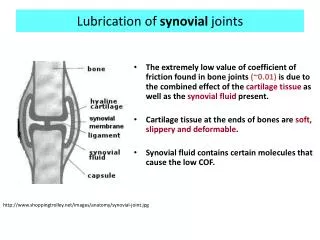
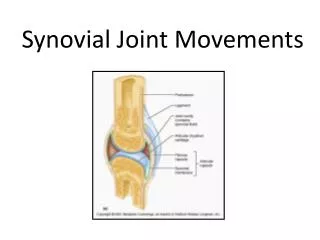
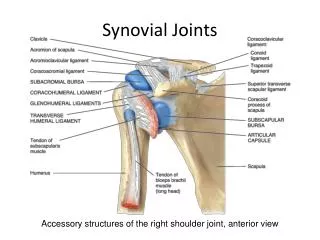
Joint Capsule • Fits over the ends of two bones like a sleeve • It is composed of strong, fibrous (collagen) tissue. • The sleeve is oversized to allow for joint motion. • It is nourished by blood vessels which give it the ability to repair itself after injury
Ligaments • Connect two bones together • Ligaments are a specialized part of this sleeve • Account for the primary stability of the joint. • Many joints also have internal ligaments that contribute to support, such as the cruciate ligaments of the knee.
Articular Cartilage • Cushion bone ends • Reduce friction • Sustained by internal blood vessels
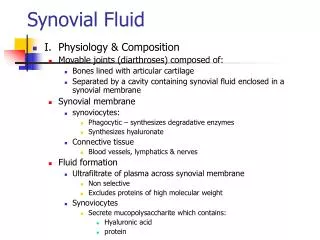
Synovial Membrane • Synovium • Produces Synovial fluid • The prime lubricant for the joint and • The nutritional source for joint surface cartilage and meniscus cartilage
Meniscus • Ten percent of synovial joints have a washer-like structure between bone ends called the meniscus • Its purpose is to absorb shock, to stabilize the joint, and to spread synovial fluid. • Made out of fibro-cartilage, which is a different tissue type from joint surface cartilage
The meniscus also has no blood supply, no nerves, and no lymphatic channels. • Biologically, it can't heal itself. • The knee meniscus is the most famous and most injured