
Support Vector Machines
E N D
Presentation Transcript
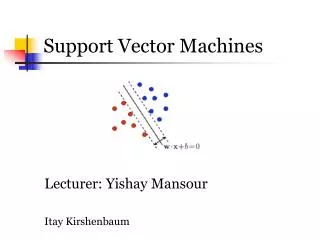
Perceptron Revisited: Linear Separators • Binary classification can be viewed as the task of separating classes in feature space: wTx + b = 0 wTx + b > 0 wTx + b < 0 f(x) = sign(wTx + b)
Linear Separators • Which of the linear separators is optimal?
Classification Margin • Distance from example to the separator is • Examples closest to the hyperplane are support vectors. • Marginρof the separator is the width of separation between classes. ρ r
Maximum Margin Classification • Maximizing the margin is good according to intuition and PAC theory. • Implies that only support vectors are important; other training examples are ignorable.
Linear SVM Mathematically • Assuming all data is at distance 1 from the hyperplane, the following two constraints follow for a training set {(xi,yi)} • For support vectors, the inequality becomes an equality; then, since each example’s distance from the hyperplane is the margin is: wTxi+ b≥ 1 if yi= 1 wTxi+ b ≤ -1 if yi= -1
Linear SVMs Mathematically (cont.) • Then we can formulate the quadratic optimization problem: A better formulation: Find w and b such that is maximized and for all {(xi,yi)} wTxi+ b≥ 1 if yi=1; wTxi+ b ≤ -1 if yi= -1 Find w and b such that Φ(w) =½ wTw is minimized and for all {(xi,yi)} yi (wTxi+ b)≥ 1
Solving the Optimization Problem • Need to optimize a quadratic function subject to linear constraints. • Quadratic optimization problems are a well-known class of mathematical programming problems, and many (rather intricate) algorithms exist for solving them. • The solution involves constructing a dual problem where a Lagrange multiplierαi is associated with every constraint in the primary problem: Find w and b such that Φ(w) =½ wTw is minimized and for all {(xi,yi)} yi (wTxi+ b)≥ 1 Find α1…αNsuch that Q(α) =Σαi- ½ΣΣαiαjyiyjxiTxjis maximized and (1)Σαiyi= 0 (2) αi≥ 0 for all αi
The Optimization Problem Solution • The solution has the form: • Each non-zero αi indicates that corresponding xi is a support vector. • Then the classifying function will have the form: • Notice that it relies on an inner product between the test point xand the support vectors xi – we will return to this later! • Also keep in mind that solving the optimization problem involved computing the inner products xiTxj between all training points! w =Σαiyixi b= yk- wTxkfor any xksuch that αk 0 f(x) = ΣαiyixiTx + b
Soft Margin Classification • What if the training set is not linearly separable? • Slack variablesξican be added to allow misclassification of difficult or noisy examples. ξi ξi
Soft Margin Classification Mathematically • The old formulation: • The new formulation incorporating slack variables: • Parameter C can be viewed as a way to control overfitting. Find w and b such that Φ(w) =½ wTw is minimized and for all {(xi,yi)} yi (wTxi+ b)≥ 1 Find w and b such that Φ(w) =½ wTw + CΣξi is minimized and for all {(xi,yi)} yi(wTxi+ b)≥ 1- ξi and ξi≥ 0 for all i
Soft Margin Classification – Solution • The dual problem for soft margin classification: • Neither slack variables ξinor their Lagrange multipliers appear in the dual problem! • Again, xi with non-zero αiwill be support vectors. • Solution to the dual problem is: Find α1…αNsuch that Q(α) =Σαi- ½ΣΣαiαjyiyjxiTxjis maximized and (1)Σαiyi= 0 (2) 0 ≤αi≤ C for all αi But neither w nor b are needed explicitly for classification! w =Σαiyixi b= yk(1- ξk) - wTxkwhere k = argmax αk f(x) = ΣαiyixiTx + b k
Theoretical Justification for Maximum Margins • Vapnik has proved the following: The class of optimal linear separators has VC dimension h bounded from above as where ρ is the margin, D is the diameter of the smallest sphere that can enclose all of the training examples, and m0is the dimensionality. • Intuitively, this implies that regardless of dimensionality m0 we can minimize the VC dimension by maximizing the margin ρ. • Thus, complexity of the classifier is kept small regardless of dimensionality.
Linear SVMs: Overview • The classifier is a separating hyperplane. • Most “important” training points are support vectors; they define the hyperplane. • Quadratic optimization algorithms can identify which training points xi are support vectors with non-zero Lagrangian multipliers αi. • Both in the dual formulation of the problem and in the solution training points appear only inside inner products: f(x) = ΣαiyixiTx + b Find α1…αNsuch that Q(α) =Σαi- ½ΣΣαiαjyiyjxiTxjis maximized and (1)Σαiyi= 0 (2) 0 ≤αi≤ C for all αi
x 0 x 0 Non-linear SVMs • Datasets that are linearly separable with some noise work out great: • But what are we going to do if the dataset is just too hard? • How about… mapping data to a higher-dimensional space: x2 x 0
Non-linear SVMs: Feature spaces • General idea: the original feature space can always be mapped to some higher-dimensional feature space where the training set is separable: Φ: x→φ(x)
The “Kernel Trick” • The linear classifier relies on inner product between vectors K(xi,xj)=xiTxj • If every datapoint is mapped into high-dimensional space via some transformation Φ: x→φ(x), the inner product becomes: K(xi,xj)= φ(xi)Tφ(xj) • A kernel function is some function that corresponds to an inner product into some feature space. • Example: 2-dimensional vectors x=[x1 x2]; let K(xi,xj)=(1 + xiTxj)2, Need to show that K(xi,xj)= φ(xi)Tφ(xj): K(xi,xj)=(1 + xiTxj)2,= 1+ xi12xj12 + 2 xi1xj1xi2xj2+ xi22xj22 + 2xi1xj1 + 2xi2xj2= = [1 xi12 √2 xi1xi2 xi22 √2xi1 √2xi2]T [1 xj12 √2 xj1xj2 xj22 √2xj1 √2xj2] = = φ(xi)Tφ(xj), where φ(x) = [1 x12 √2 x1x2 x22 √2x1 √2x2]
What Functions are Kernels? • For some functions K(xi,xj) checking that K(xi,xj)= φ(xi)Tφ(xj) can be cumbersome. • Mercer’s theorem: Every semi-positive definite symmetric function is a kernel • Semi-positive definite symmetric functions correspond to a semi-positive definite symmetric Gram matrix: K=
Examples of Kernel Functions • Linear: K(xi,xj)= xi Txj • Polynomial of power p: K(xi,xj)= (1+xi Txj)p • Gaussian (radial-basis function network): K(xi,xj)= • Two-layer perceptron: K(xi,xj)= tanh(β0xi Txj + β1)
Non-linear SVMs Mathematically • Dual problem formulation: • The solution is: • Optimization techniques for finding αi’s remain the same! Find α1…αNsuch that Q(α) =Σαi- ½ΣΣαiαjyiyjK(xi,xj)is maximized and (1)Σαiyi= 0 (2) αi≥ 0 for all αi f(x) = ΣαiyiK(xi,xj)+ b
SVM applications • SVMs were originally proposed by Boser, Guyon and Vapnik in 1992 and gained increasing popularity in late 1990s. • SVMs are currently among the best performers for a number of classification tasks ranging from text to genomic data. • SVM techniques have been extended to a number of tasks such as regression [Vapnik et al. ’97], principal component analysis [Schölkopf et al. ’99], etc. • Most popular optimization algorithms for SVMs are SMO [Platt ’99] and SVMlight[Joachims’ 99], both use decomposition to hill-climb over a subset of αi’s at a time. • Tuning SVMs remains a black art: selecting a specific kernel and parameters is usually done in a try-and-see manner.