Download
1 / 2
20 likes | 120 Vues
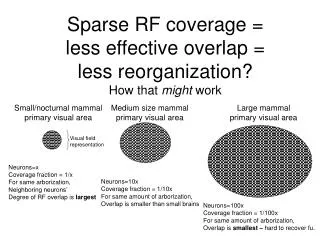
Learn how adjusting neuronal coverage fractions impacts overlap in visual field representation across mammals of different sizes. Lower overlap in larger mammals could lead to more efficient processing.

E N D
Sparse RF coverage = less effective overlap = less reorganization?How that might work Small/nocturnal mammal primary visual area Medium size mammal primary visual area Large mammal primary visual area Visual field representation Neurons=x Coverage fraction = 1/x For same arborization, Neighboring neurons’ Degree of RF overlap is largest Neurons=10x Coverage fraction = 1/10x For same amount of arborization, Overlap is smaller than small brains Neurons=100x Coverage fraction = 1/100x For same amount of arborization, Overlap is smallest – hard to recover fu.
1 degree Visual angle 0.5 degree Visual angle 0.1 degree Visual angle Overlap n.b. these are made-up numbers, but illustrate that the same density and arborization across cells, but with different overall numbers of cells used to represent the visual field, leads to less overlap in adjacent neurons for many-neuroned brains (big V1s)