Understanding Lesion Studies in Cognitive Neuroscience: Approaches and Implications
Lesion studies play a vital role in understanding human cognition through an experimental approach. These studies involve examining the effects of brain damage, whether from trauma, stroke, or surgical intervention, on cognitive functions. Techniques such as aspiration and electrolytic lesions, as well as reversible methods like transcranial magnetic stimulation, offer insights into specific brain areas' roles. While using animal models can be useful, the preference for human research remains paramount, unless constraints necessitate an alternative approach. Understanding the logic behind lesion studies helps unravel the complexities of cognitive deficits and neural pathways.

Understanding Lesion Studies in Cognitive Neuroscience: Approaches and Implications
E N D
Presentation Transcript
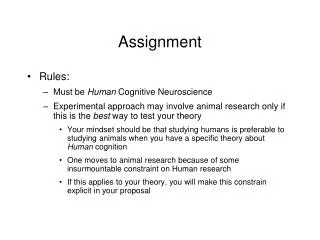
Assignment • Rules: • Must be Human Cognitive Neuroscience • Experimental approach may involve animal research only if this is the best way to test your theory • Your mindset should be that studying humans is preferable to studying animals when you have a specific theory about Human cognition • One moves to animal research because of some insurmountable constraint on Human research • If this applies to your theory, you will make this constrain explicit in your proposal L
Lesion Studies • Logic of Lesion Studies: • damaged area plays a role in accomplishing whatever task is deficient after the lesion
Lesion Studies • Types of Lesions • Animal • Human
Lesion Studies • Animal Lesion Techniques • Aspiration Lesions • Electrolytic Lesions
Lesion Studies • Animal Lesion Techniques • Aspiration Lesions • Electrolytic Lesions • Problems: • These can damage surrounding tissue - especially white matter tracts nearby (“fibers of passage”) • Irreversible • eventual degradation of connected areas
Lesion Studies • Animal Lesion Techniques • Vascular Lesions • endothelin-1 • good model of human stroke • severe damage • not pinpoint accuracy
Lesion Studies • Animal Lesion Techniques • Reversible Lesions • Cooling • highly selective • can cool specific layers of cortex • can be reversed!
Lesion Studies • Animal Lesion Techniques • Selective Pharmacological lesions • damage or destroy entire pathways that have a specific sensitivity to a particular chemical • e.g. MPTP model of Parkinson’s Disease (frozen addicts) • e.g. scapolomine - acetylcholine antagonist - temporary amnesia • Can be selective for specific circuits but not for specific brain areas • can be reversible in some cases (e.g. scopolamine, but not MPTP)
Lesion Studies • Animal Lesion Techniques • Gene Knock-Out • can selectively block expression of specific receptor types • animal developes differently
Lesion Studies • Human Lesions • Ischemic Events • Stroke and Hemorrhage: • typically due to blood clot or hemorrhage • size of lesion depends on where clot gets lodged • amount of damage depends on how long clot remains lodged
Lesion Studies • Human Lesions • Trauma • Frontal lobes are particularly susceptible • Some famous cases (e.g. Phineas Gage)
Lesion Studies • Human Lesions • Surgery • Often surgery done to treat epilepsy • Occasionally corpus callosum is severed • Problem: patient wasn’t “normal” before the surgery
Lesion Studies • Human Lesions • Transcranial Magnetic Stimulation • Electromagnet Induces current in the brain • very transient, very focal reversible “lesion” • Believed to be safe • sites that can be studied are limited by the geometry of the head
Lesion Studies • Making sense of Lesion studies
Lesion Studies • Why are there only certain kinds of deficits associated with lesions? Why not every possible deficit?
Lesion Studies • Logic of Lesion Studies: • damaged area plays a role in accomplishing whatever task is deficient after the lesion • Warning: • This isn’t the same as saying the lesioned area “does” the operation in question • examples: • normal behaviour may be altered to accommodate lesion • e.g. sensory loss of one arm favors other arm • lesion might cause “upstream problem” or general deficit • e.g. attention problem “looks like” specific deficit if you only test one specific demanding task