The Struggle of Labor Unions in Early 20th Century America
The American Federation of Labor (AFL) emerged as a key organization representing trade unions and advocating for workers' rights to negotiate collectively. By 1890, the AFL saw a majority of factory workers in industries like tobacco, garments, and textiles. Pioneering figures like Mary Harris Jones highlighted children's exploitation in these mills. The tragic Triangle Shirtwaist Factory fire of 1911 exposed the dire safety conditions faced by workers. Strikes often resulted in government intervention favoring owners, leading to a mixed reputation for labor movements, but they were crucial for progress despite intense opposition.

The Struggle of Labor Unions in Early 20th Century America
E N D
Presentation Transcript
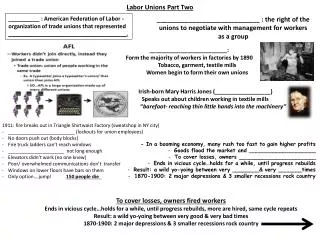
__________ : American Federation of Labor - organization of trade unions that represented ______________________________________. • _____________________________ : the right of the unions to negotiate with management for workers as a group • _________________________: • Form the majority of workers in factories by 1890 • Tobacco, garment, textile mills • Women begin to form their own unions Labor Unions Part Two • Irish-born Mary Harris Jones (__________________) • Speaks out about children working in textile mills • “barefoot- reaching thin little hands into the machinery” • 1911: fire breaks out in Triangle Shirtwaist Factory (sweatshop in NY city) • _________________________ (lockouts for union employees) • No doors push out (body blocks) • Fire truck ladders can’t reach windows • _____________________ not long enough • Elevators didn’t work (no one knew) • Poor/ overwhelmed communications don’t transfer • Windows on lower floors have bars on them • Only option….jump! 150 people die • - In a booming economy, many rush too fast to gain higher profits • Goods flood the market and ____________________ • To cover losses, owners _______________________ • Ends in vicious cycle…holds for a while, until progress rebuilds • Result: a wild yo-yoing between very ________& very _______times • 1870-1900: 2 major depressions & 3 smaller recessions rock country • To cover losses, owners fired workers • Ends in vicious cycle…holds for a while, until progress rebuilds, more are hired, same cycle repeats • Result: a wild yo-yoing between very good & very bad times • 1870-1900: 2 major depressions & 3 smaller recessions rock country
After Economy Has a Short Time to Re-boost… ____________________ __________ Factories & Faster Work Price Drops How difficult would it have been to support a family in such conditions? - ______________________ - Low $$ - Safety or harassment - Injuries, health and sanitation? When Workers Go On Strike… • Gov’t usually sided with owners • Political reasons • _______________ • They are the people who are “responsible” for creating economic booms which the country needs • Who is actually responsible for turning out production??? • Presidents send in troops/ military/ police to intimidate strikers • _______________________________________________ Strikes get a bad reputation… but why? • They result in progress- but ________________________ • Because of instances like _____________________, many strikes are associated with riots & anarchists or “extremists” • Intimidation by the _____________________ makes people want to support strikes less and less