
Social Development
E N D
Presentation Transcript
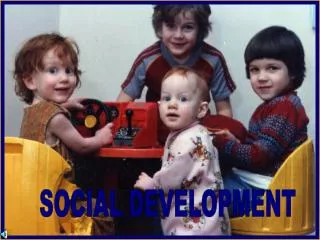
Social Development The changing nature of relationships with others over the life span
What Are the Issues ? • Individuals develop socially. How do social relationships develop? • What factors drive social development? • biological • cultural • cognitive
Erikson’s Theory • Biological in belief that there are innate drives to develop social relationships and that these promote survival (Darwinism) • Divided life span into eight psychosocial stages, each associated with a different drive and a problem or crisis to resolve • Outcome of each stage varies along a continuum from positive to negative
Stage 1 (birth - 1)Trust vs. Mistrust • Infants must rely on others for care • Consistent and dependable caregiving and meeting infant needs leads to a sense of trust • Infants who are not well cared for will develop mistrust
Stage 2 (1-3 years) Autonomy vs. Shame and Doubt • Children are discovering their own independence • Those given the opportunity to experience independence will gain a sense of autonomy • Children that are overly restrained or punished harshly will develop shame and doubt
Stage 3 (3-5 years)Initiative vs. Guilt • Children are exposed to the wider social world and given greater responsibility • Sense of accomplishment leads to initiative, whereas feelings of guilt can emerge if the child is made to feel too anxious or irresponsible
Stage 4 (5-12 years) Industry vs. Inferiority • Stage of life surrounding mastery of knowledge and intellectual skills • Sense of competence and achievement leads to industry • Feeling incompetent and unproductive leads to inferiority
Stage 5 (adolescence)Identity vs. Confusion • Developing a sense of who one is and where s/he is going in life • Successful resolution leads to positive identity • Unsuccessful resolution leads to identity confusion or a negative identity
Stage 6 (young adulthood)Intimacy vs. Isolation • Time for sharing oneself with another person • Capacity to hold commitments with others leads to intimacy • Failure to establish commitments leads to feelings of isolation
Stage 7 (middle adulthood)Generativity vs. Stagnation • Caring for others in family, friends and work leads to sense of contribution to later generations • Stagnation comes from a sense of boredom and meaninglessness
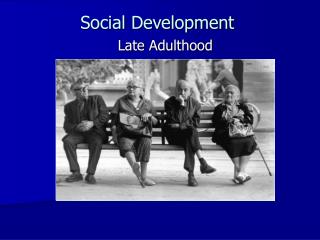
Stage 8 (late adulthood to death)Integrity vs. Despair • Successful resolutions of all previous crises leads to integrity and the ability to see broad truths and advise those in earlier stages • Despair arises from feelings of helplessness and the bitter sense that life has been incomplete
Bronfenbrenner’s Social Ecology Theory • Network of interactions and interdependencies among people, institutions and cultural context
Infant Attachment • Intense emotional bond between infant and caregiver
Harlow’s Study of Attachment • Infant rhesus monkeys were placed with two surrogate mothers, one made of wire and one covered with soft cloth • Milk-producing nipple was attached to either the wire or the cloth mother • Attachment was based on “contact comfort” rather than feeding
Ainsworth’s Strange Situation • Mother-child dyads were observed in a playroom under four conditions: • initial mother-child interaction • mother leaves infant alone in playroom • friendly stranger enters playroom • mother returns and greets child
Forms of Attachment • Securely attached - explores the room when mother is present, becomes upset and explores less when mother is not present, shows pleasure when mother returns • Avoidantly attached - a form of insecure attachment in which child avoids mother and act coldly to her
Forms of Attachment • Anxious resistant attachment - a form of insecure attachment where the child remains close to mother and remains distressed despite her attempts to comfort
Hoffman’s Categories of Discipline • Power assertion - use of rewards and real or threatened punishments to control children’s behavior • Love withdrawal - expressing disapproval of child rather than action • Induction - verbal reasoning in which parent induces child to think about harmful consequences of actions
Baumrind’s Parenting Styles • Authoritarian - value obedience and use a high degree of power assertion • Authoritative - less concerned with obedience, greater use of induction • Permissive - most tolerant, least likely to use discipline • Neglectful - completely uninvolved
Kohlberg’s Theory of Moral Development • Assessed moral reasoning by posing hypothetical moral dilemmas and examining the reasoning behind people’s answers • Proposed five stages, each taking into account a broader portion of the social world
Levels of Moral Reasoning • Preconventional - moral reasoning is based on external rewards and punishments • Conventional - laws and rules are upheld simply because they are laws and rules • Postconventional - reasoning based on personal moral standards
Stage 1: Obedience and Punishment Orientation • A focus on direct consequences • Negative actions will result in punishments • Positive actions will result in rewards
Stage 2: Self-Interested Exchanges • Reflects the understanding that different people have different self-interests, which sometimes come in conflict • Getting what one wants often requires giving something up in return
Stage 3: Interpersonal Accord and Conformity • An attempt to live up to the expectations of important others • Positive actions will improve relations with significant others • Negative actions will harm those relationships
Stage 4: Law-and-Order Morality • To maintain social order, people must resist personal pressures and follow the laws of the larger society
Stage 5: Human-Rights and Social-Welfare Morality • A balance is struck between respect for laws and ethical principles that transcend specific laws • Laws that fail to promote general welfare or that violate ethical principles can be changed, reinterpreted, or abandoned