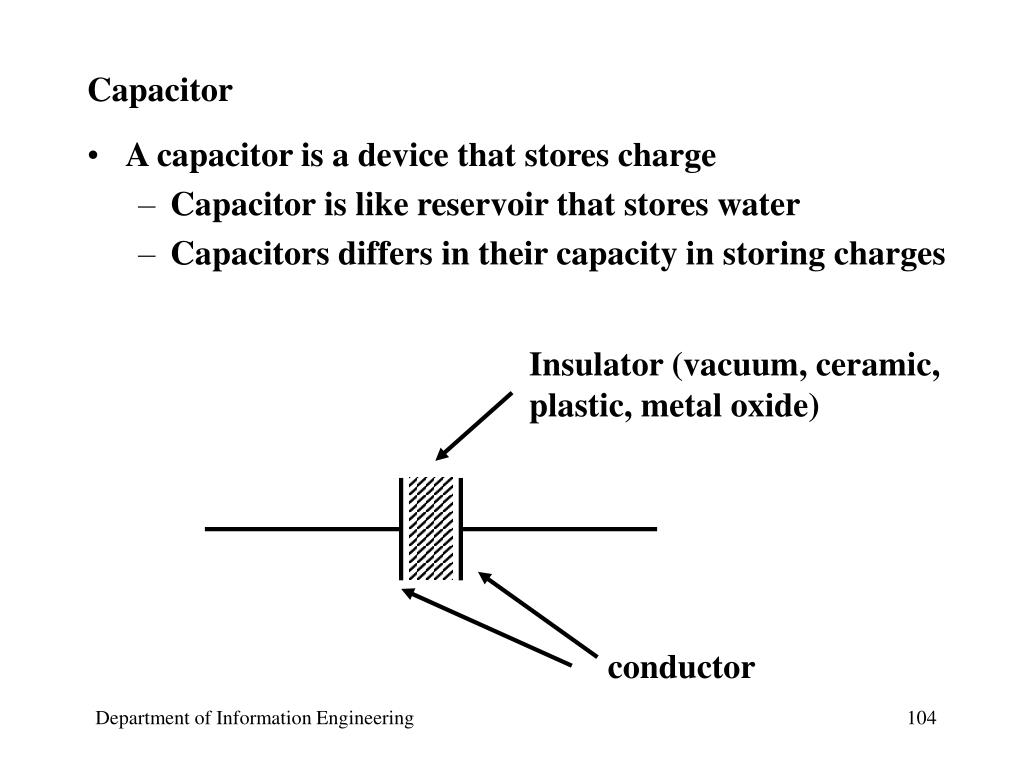
Capacitor. A capacitor is a device that stores charge Capacitor is like reservoir that stores water Capacitors differs in their capacity in storing charges. Insulator (vacuum, ceramic, plastic, metal oxide). conductor. Charge up a capacitor. Initially V C = 0,. I. R. V C =0. V.
Une image / un lien ci-dessous est fourni (tel quel) pour télécharger la présentation
Politique de téléchargement : le contenu du site vous est fourni TEL QUEL pour votre information et votre usage personnel ; il ne peut être vendu, concédé sous licence ni partagé sur d’autres sites sans l’accord de son auteur.Le contenu vous est fourni TEL QUEL, pour votre information et votre usage personnel uniquement.Téléchargez la présentation en cliquant sur ce lien.Lors du téléchargement, si vous ne parvenez pas à télécharger une présentation, l’éditeur a peut-être supprimé le fichier de son serveur.Pendant le téléchargement, si vous ne parvenez pas à obtenir une présentation, le fichier a peut-être été supprimé par l’éditeur.
F I N
Plus de contenu associé
Transcription de la présentation
Capacitor • A capacitor is a device that stores charge • Capacitor is like reservoir that stores water • Capacitors differs in their capacity in storing charges Insulator (vacuum, ceramic, plastic, metal oxide) conductor
Definition of Capacitor • Tub stores water, capacitor stores charge • C = Tub size • Q = Volume of water • V = Height of water level • I = Rate of flow of water • If a capacitor contains Q amount of water (charges), and the height of water (V), then the size is given by
Capacitor • C = size of the capacitor Same charge (Q) but different V V V Large cap Small cap
Capacitors in parallel • What is the combined capacitance C? • Two tubs in parallel, can store more water, C should be larger C? V V = C2 C1
Capacitor in parallel (C = C1+C2 ) • Parallel circuit, same voltage across C1 and C2 • Q1 = C1V, Q2 = C2V • Total charge Q=Q1+Q2=(C1+C2)V • C = = C1+ C2 V C2 C1 Q Same V for C1 and C2 V V C2 C1
Capacitor • Dump dQ amount of water to a tub of size C, so that the water level is changed by dV • But • Hence • i.e. the rate of change of the height of water is proportional to the current (inflow of water)
Constant I • Rate of increase of V = I/C, • If I is constant, voltage increases constantly
DC and AC circuits • DC (direct current) circuits • voltage is constant over time • e.g. battery or lab power supply • AC (alternate current) circuits • voltage is varying over time • Extremely important! Signal is represented as voltage variation • e.g. your voice, modem signal, data signal
DC circuit • Initially VC =VC(0), find VC (t) I R VC V0
Example - charging a capacitor • At t=0, VC=0. What is VC(t)? • Destination=V0 • Distance=V0-0=V0 • VC(t) = V0-V0e-t/RC = V0(1-e-t/RC) I R VC V0
RC circuit • Charging curve for R = 1k, C = 1mF, RC = 1ms I=CdVcap/dt ~ 0
How long does it take to charge up the capacitor? • Depends on RC (the time constant) • t=RC: VCAP(t) = 0.63 V0 • t=5RC: VCAP(t) = 0.99 V0 • t=5RC, the capacitor is almost fully charged up • (to fully charge up a capacitor 100% takes infinitely long time, not practical) • R = 1k, C = 1mF, takes around 5ms to charge up
Example • Initially VC = 5V, V0=15V, find VC(t). • Destination=15 • Distance=15-5=10 • Answer: VC(t) = 15 - 10e-t/RC I R VC(0)=5V V0=15V
Example: discharging a capacitor • Initially VC = 15V, V0= 0V, what is VC(t)? • Destination=0V • Distance=0-15=-15V • Solution: VC(t) = 0 - (-15)e-t/RC = 15e-t/RC I R VC(0)=15V V0=0V
The importance of sinusoids • In real world, interesting signals are time-varying • if we pass the time-varying signal to a linear system, what is the output response? Linear System (resistor, capacitor, and inductor) ?
Sunglass example • Sunglass is used to filter sun light • Sun light is a varying signal, how to analyze it? Sun light
Principle of superposition!! • Sun light = sum of light with different wavelengths • Each individual light has a frequency and a wavelength + Sun light
Characteristic of a filter • The filter (sunglass) can be characterized by its frequency response, that depends on only two parameters • The attenuation factor (V2/V1) • The phase (angle) change q q V1 V2
Fourier theorem: signal = sum of sinusoids = sum of sinusoids Input Output = sum of sinusoids’ response Input Output response decompose sum Sinusoidal responses Linear System sinusoids
How to represent a sine wave (sinusoid)? • A sine wave • (unit in radian) • Make , so that is a function of time, • Unit of w : Radian/second • We have • For sinusoidal signal, one cycle = 2p radian • If the rate of rotation = f cycle/s, then w=2pf (rad/s)
Example : square wave = sum of sine waves !! • Periodic square wave f(wo) at frequency wo • 1kHz square wave = 1kHz + 3kHz +5kHz + . . . (sine waves) Fundamental freq Harmonics
Your ear • Why our inner ear has this shape? Shape of a cochlea A stretch out cochlea
Sinusoidal response of capacitor • Let V = A cos wt (w = 2pf) • I = C dV/dt = - wC Asin wt • Impedance = , complex relation because V and I are not in phase I leads V by 900 I ~ V V I
j - complex number notation • V and I are not in phase • Apart from the ratio of magnitude between V and I • Also need to know the phase angle between V and I • To keep track with the magnitude and phase information • sin and cosine are tedious to use • Simpler to use a the j-notation
A mathematician game • The board • 2 dimensional complex plane • x-axis represents the real axis • The player • a vector (e.g. 1) on the plane • The rule • j represents an operation that rotates a vector anticlockwise by 90o on the complex plane x 1
j • j*1 = j (meaning rotate vector 1 by 90o) • j*j=j2 = -1 (rotates the vector j by 90o) • Therefore j 1 j2 1 1 j3 1
j - complex number notation • a+jb • Sum of vector a and jb • Represent a vector with a magnitude and phase • Magnitude = • Phase q = • a vector with magnitude = 1 making angle q with real axis jb q a q 1
Euler formula • Euler formula • Proof by series expansion of ex ejq q 1
Complex sinusoid ejwt • Represents a rotating vector that rotates at a rate of f cycles/sec ( ) Direction of rotation ejwt wt 1
Real part of complex sinusoid • R{ . } denotes the real part of something • Example • V = A cos wt = R { A ejwt } because • V = R { A ejwt } = R { A(cos wt + j sin wt) } = A cos wt • If V = A cos (wt+f), then V = R { A ej(wt+f) } • Without loss of generality, we shall assume f=0 so as to simplify our calculation
Impedance of a capacitor • To recover V and I, take the real part • V = R { A ejwt } = A cos wt • I = R { jwC Aejwt } = R { jwC A (cos wt + j sin wt) } = - wC A sin wt (Ohm’s law for capacitor)
Impedance of a capacitor (XC) • magnitude of impedance = • Small w=>low frequency => ZC is large => open circuit • Large w=>high frequency => ZC is small => short circuit
Circuit analysis • If V2 is a varying signal, what is V2? R C V2 V1
Impedance of capacitor • Definition • Impedance of capacitor = • By KVL • So that • Hence
Transfer function T(w) • Transfer function T(w)= Output / Input = • Note that the output response depends on the frequency of the input sinusoid
Connexion au compte
Connectez-vous pour publier votre contenu sur SlideServe.