The Importance of Parental Engagement in Student Success
Research emphasizes that parental engagement significantly influences student achievement, contributing up to 80% of their success. Effective parental engagement goes beyond mere involvement; it's about actively participating in their child’s learning and establishing a supportive environment. Key elements include academic socialization, understanding one’s role in education, and adopting a supportive parenting style. Parents can enhance their child’s learning without requiring extensive resources or time—simple actions like discussing school activities and maintaining open communication can lead to improved academic outcomes, social skills, and overall well-being.


The Importance of Parental Engagement in Student Success
E N D
Presentation Transcript
Parental Engagement Lessons from research
Why is it important? • SER (2000)suggests that the relative influence of the home on student achievement is between 60-80% • Hattie (2008) states 70% of student achievement is attributed to what they bring with them to school – their innate ability, their attitudes, their socio-economic status, the amount of television they watch etc. • Plowden report (1967) asserted that schools make little difference to student outcomes.
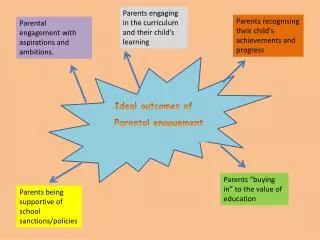
What difference can it make? • Higher grades • Enrolment in higher level programs/advanced classes • Higher graduatation rates • Higher tertiary education enrolments • Better social skills • Improved behaviour • Regular school attendance • Greater engagement in school work
Economic modelling • Parental effort compared with school resources was equivalent to $1000 extra funding per student • Or • Equivalent to an additional 4-6 years of education for parents.
Parent engagement versus parent involvement • Big difference between involving parents in schooling and involving parents in learning • Whilst parental engagement does clearly affect student academic attainment, parental involvement has very little effect • Some types of parental involvement can actually have a negative effect • The surveillance approach (monitoring student homework) • Controlling and disciplining parental style
Effective Parental Engagement • 3 main principles • Academic socialisation • Parental role construction • Parenting style
Academic Socialisation • Communicating with children about parental expectations for education and the value and enjoyment of learning • Discussing learning strategies with children • Linking schoolwork to current events and other topics • Providing a stimulating home learning environment • Making learning enjoyable and rewarding • Focusing on activities such as decision-making and problem solving, affirming their autonomy and independence.
Parental Role Construction • How you perceive your role in your child’s education • Beliefs about appropriate and desirable child outcomes • Beliefs about who is responsible for these outcomes • Belief in your ability to help • Perceptions about what teachers, friends and family expect from you
Parenting Style • Supportive • Encourages conversation • Make reasons behind rules transparent • Acknowledge responsibility of child • Conversely • Emotionally distant yet high expectations can lead to low levels of self esteem which can flow on to negative impact on academic acheivement
Excessive pressure on a student to excel may be detrimental to their well-being • All parental engagement should be first and foremost about enhancing student well-being.
Summary • Parents do not need to invest a significant amount of time or acquire specialised knowledge in order to assist their child in learning. • Good at-home parenting is effective • Demonstrate a genuine interest in their learning • Setting up a designated area for homework • Provide educational resources • Discussing subject choices, academic aspirations • Talking to them about their school, films, books
Great questions to ask • What do you know now that you didn’t know this morning?
Which story did your teacher read to the class today? • What was your favourite part of the story? • What was the hardest thing you had to do today? • What are you looking forward to at school tomorrow? • What has been your most favourite activity this week? • What was your favourite part of your day? • Did you get frustrated with anything at school today? • Were you able to finish all of your work today? • Do you have any questions that maybe your teacher couldn’t answer? • Is there anything that you are learning in class that you would like to know more about?
Summary continued….. • Actively getting involved with their learning, taking them to museums, exhibitions etc • Open dialogue between school and home • Read newsletters, email teachers and find out what they are learning about in class. • Know what is going on at school • Trust between home and school is vital