Download
1 / 6
70 likes | 204 Vues
This overview explores the fascinating world of rocks and minerals. It discusses the defining characteristics of minerals as naturally occurring, inorganic solids with a specific atomic arrangement. The formation of crystals is highlighted, detailing how crystal size is influenced by cooling rates of magma and lava. Methods of mineral identification such as hardness, luster, color, streak, and cleavage are explained, along with examples of minerals like talc, quartz, and diamond. Learn to recognize the crucial traits that categorize and distinguish various minerals.

E N D
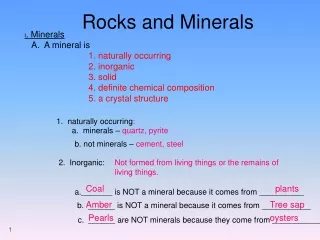
Minerals • A naturally occuring, inorganic, solid with a definate composition and an orderly arrangement of atoms.
Crystals • A mineral will form crystals when the atoms arrange in a pattern. The larger the crystal the longer it took to develop. Minerals formed when magma cools slowly will form large crystals. When lava cool rapidly it will form very small crystals. They may be to small to see with the naked eye. Crystals can also form from dissolved liquids.
Mineral identification • 1. Hardness • 2. Luster • 3. Color • 4. Streak • 5. Cleavage and fracture
1 2 3 4 5 6 7 8 9 10 Scratched by finger nail Scratched by steel knife Will scratch glass - gemstones Talc Gypsum Calcite Fluorite Apatite Moonstone Quartz Topaz Corundum Diamond Hardness • The measure of how easily a mineral can be scratched.
Luster • Describes how light reflects from a minerals surface. Luster is defined as either metallic or nonmetallic.