Download

1 / 3
30 likes | 135 Vues
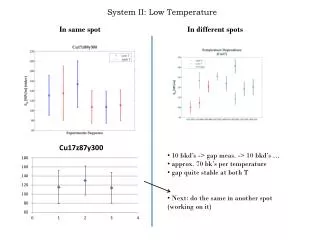
Incorporating sample temperature control in DC Spark System II enables diverse measurements, from determining the direct impact of temperature on breakdown rate to in-situ annealing. Despite previous setbacks, the repaired controller now operates efficiently, ensuring precise regulation within the nominal range of -180°C to +1000°C. Anders Korsbäck's overview details the intricate process, emphasizing the electron bombardment technique for sample heating and feedback control mechanism. The recent repairs and successful trials mark a significant milestone in enhancing the system's functionality.

E N D
Temperature Control in DC Spark System II Anders Korsbäck
Context • Introducing sample temperature control into DC Spark System II makes several interesting measurements possible • Direct effect of temperature on breakdown rate • In-situ annealing of samples • Temperature control was originally attempted in 2011-2012 but abandoned • Lack of gap distance control to compensate for thermal expansion • Temperature controller was damaged and broken in lab mishap • Installation of liquid nitrogen line in lab was delayed • Time was running out for people, other things got priority • Controller has now been repaired and put together after many trials and even more errors (thanks to Kyrre for helping out!) Anders Korsbäck
Overview of controller • Sample heating is carried out by electron bombardment of a plate in thermal (but not electrical – our modification) contact with sample • Filament is heated ohmically, thermally emitted electrons are accelerated by 650 V potential to hit heater anode and deposit their kinetic energy into it • EBHC runs feedback control, using thermocouple reading as input signal and regulating the filament voltage and current • Nominal temperature range -180 °C to +1000°C (+1200 °C without cooling) Anders Korsbäck