
Do We Really Need Soil?
E N D
Presentation Transcript
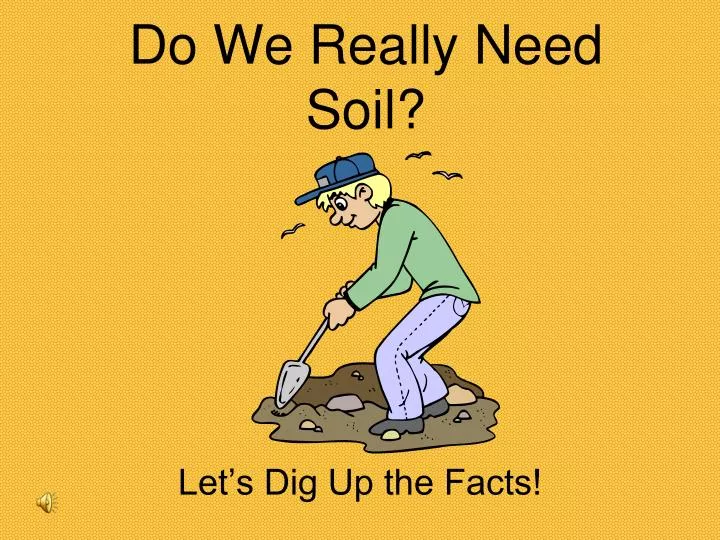
Do We Really Need Soil? Let’s Dig Up the Facts!
Soil Components • True soil is made up of 4 key components. • Think MOMA to remember them • Minerals • Organic Material & Bacteria • Moisture • Air
Soil Components… 1. Minerals: • Minerals such as calcium, phosphorous and Potassium are nutrients that are found in the soil and are required for plant growth. • Minerals come from rock material known as parent material • Minerals are acquired through the weathering (breaking down) process into smaller elements such as sand, silt and clay
Soil Components… 2. Organic Material & Bacteria: • The organic material is flowers, grass, trees/branches etc that are dead and on the ground • When plants and animals die they are decomposed (broken down) by bacteria in the soil (think mold on cheese or bread) • Decaying organic materials form humus, which provides nutrients and moisture for plants. - Humus is dark in colour and found on the surface or O horizon (layer)
Soil Components… 3. Moisture: • - Water dissolves nutrients and is absorbed by the roots of plants. • - Water also necessary dissolve minerals and help in the decay of organic material.
Soil Components… 4. Air: - Plants need air most around their roots and within 30cm of the surface • Lots of loose humus near roots allows for lots of air spaces • Air spaces are also created by worms and ants and other insects and small animals which tunnel through the soil.
Soil Profile • Soil Profiles: A profile is a side view of something… • Soil is made up of many layers or horizons • The Profile is the different layers between the O horizon and the D (or R) (bedrock) • Each horizon is composed of different rock, minerals and vegetation combinations
Soil Profile…. D Horizon
Natural Vegetation Regions • Natural vegetation: plants that grow without human interference • 3 main types in Canada : • tundra (lichens and mosses) • forest (trees) • grassland
Natural Regions 7 natural regions (which gradually change one into the next through transition zones) • Tundra • Boreal & Taiga Forest • Mixed Forest • Deciduous Forest • Grassland; Short and Long Grassland/ Parkland • Cordilleran Vegetation • West Coast Forest. Each Natural vegetation regions has unique vegetation characteristics that usually can be connected to regions climate.