Case Study Computed Tomography (CT)
250 likes | 367 Vues
Computed Tomography (CT) is a non-invasive medical imaging technique that utilizes X-rays to create detailed cross-sectional images of the body. Unlike traditional methods such as standard X-rays, which lack spatial resolution and are limited in medical use, CT provides comprehensive insights into tissue structure. The foundations of CT were established by G. Hounsfield and A. M. Cormack, who received the Nobel Prize in 1979. While CT has numerous applications beyond medicine, like astronomy and geophysics, it also poses limitations, including potential tissue damage from ionizing radiation and challenges in soft tissue differentiation.


Case Study Computed Tomography (CT)
E N D
Presentation Transcript
Case Study Computed Tomography (CT) Non-invasive medical imaging techniques
最传统的方法 • Standard X-ray • Lost spatial information • Very limited use
Use very high frequency sound (MHz) Safe Image in real time Equipment is not expensive Limitation Strong sound absorption by bones Hard in brain studies, or anywhere with bones Ultrasound (B超) 基本原理(物理的):波的折射与反射
Computed Tomography • A parallel sheet of X-ray • Mathematical tools needed for successful computed tomography (CT) imaging • Basic principle is discovered more once • 1979 Nobel Prize in Physiology and Medicine was awarded to G. Hounsfield & A.M. Cormack jointly for realizing and bringing to medical use
Not expensive to use Some drawbacks Possible tissue damage from ionization Low contrasts between different type of soft tissues Computed Tomography
There are many applications other than medical tomography: Astronomy---binary stars, coronal study Oceangraphy---acoustic probing of ocean conditions Geophysics---mantle flow, atmospheric studies Porous Media--- Computed Tomography
Coordinate axes satisfy Model problem
Radon Transformation • Assume the density function of the test object is given by • The scan data can be written as • Question: how to recover from
To understand the idea behind, consider 3*3 small object Homogenous blocks The block densities either 0 or 1 How to achieve the reconstruction? Least Square Method
Density 1: Density 0: Least Square Method
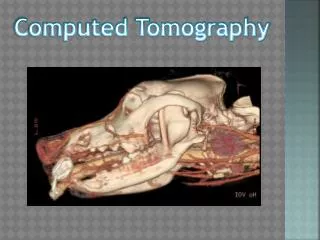
Computed Tomography 冠状动脉