Download
1 / 1
10 likes | 154 Vues
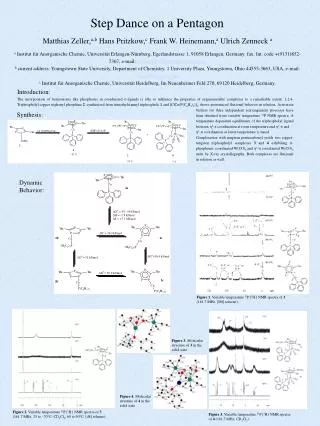
This study investigates the effects of heteroatom incorporation in ligands on organometallic complexes. Specifically, we synthesize 1,2,4-Triphospholyl copper triphenyl phosphine and demonstrate its remarkable fluxional behavior in solution. Using variable temperature 31P NMR spectra, we analyze three independent rearrangement processes and establish a temperature-dependent equilibrium involving various coordination modes of the triphospholyl ligand. Additionally, we explore the synthesis of copper-tungsten triphospholyl complexes, revealing their fluxional nature through X-ray crystallography.

E N D
Step Dance on a Pentagon Matthias Zeller,a,b Hans Pritzkow,c Frank W. Heinemann,a Ulrich Zenneck a aInstitut für Anorganische Chemie, Universität Erlangen-Nürnberg, Egerlandstrasse 1, 91058 Erlangen, Germany. fax: Int. code +(9131)852-7367, e-mail: zenneck@chemie.uni-erlangen.de b current address: Youngstown State University, Department of Chemistry, 1 University Plaza, Youngstown, Ohio 44555-3663, USA, e-mail: mzeller@cc.ysu.edu c Institut für Anorganische Chemie, Universität Heidelberg, Im Neuenheimer Feld 270, 69120 Heidelberg, Germany. Introduction: The incorporation of heteroatoms like phosphorus in coordinated -ligands is able to influence the properties of organometallic complexes to a remarkable extent. 1,2,4-Triphospholyl copper triphenyl phosphine 2, synthesized from trimethylstannyl triphosphole 1 and [ClCu(P(C6H5)3)]4, shows pronounced fluxional behavior in solution. Activation barriers for three independent rearrangement processes have been obtained from variable temperature 31P NMR spectra. A temperature dependent equilibrium of the triphospholyl ligand between 5- coordination at room temperature and 1- and 1- coordination at lower temperature is stated. Complexation with tungsten pentacarbonyl yields two copper- tungsten triphospholyl complexes 3 and 4 exhibiting - phosphorus coordinated W(CO)5 and 5- coordinated W(CO)3 units by X-ray crystallography. Both complexes are fluxional in solution as well. Synthesis: Dynamic Behavior: Figure 1. Variable temperature 31P{1H} NMR spectra of 3 (161.7 MHz, [D8] toluene). Figure 3. Molecular structure of 3 in the solid state Figure 4. Molecular structure of 4 in the solid state Figure 2. Variable temperature 31P{1H} NMR spectra of 3 (161.7 MHz, 25 to –70°C: CD2Cl2, 60 to 90°C: [d8] toluene). Figure 5. Variable temperature 31P{1H} NMR spectra of 4 (161.7 MHz, CD2Cl2).