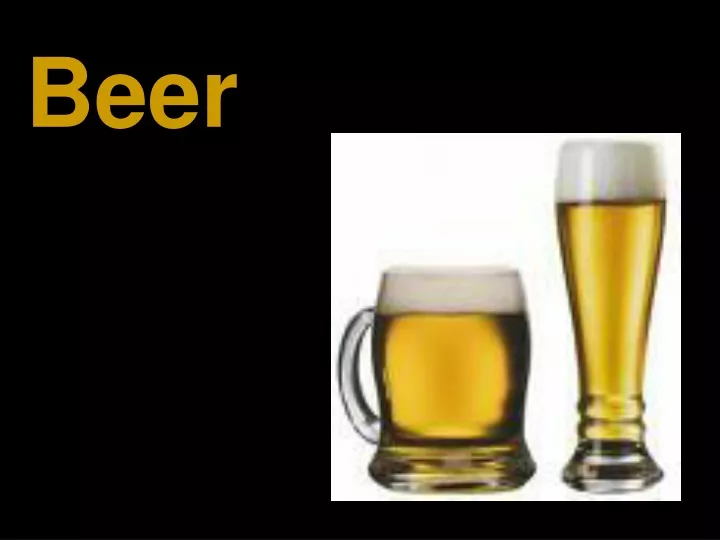

Beer
E N D
Presentation Transcript
Beer History • No True Beginning • Sumerians of Ancient Mesopotamia • First record of “Beer” • Cuneiform • Accidental discovery
U.S. Beer Timeline • 1612-1800: Beginning of Brewing in America • -The first brewery in New World established at current day Manhattan • 1800-1860: Brewing Increases in Popularity • -132 Breweries are producing 185,000 barrels of beer • 1860-1920: Brewing Becomes a Viable Industry • -IRS began taxing beer to finance the government during the Civil War • -3700 Breweries are producing 6 million barrels of beer • 1920-1933: Prohibition Days • -American Brewers Association formed • -During this time beer was outlawed
Timeline Continued • 1933-1945: Brewing is Revived -Prohibition was lifted • 1945-1980: After WWII, Prosperity Continues -Aluminum Can Introduced -Ring pull can introduced • 1980-2000: More Growth & New Aspects -Becomes legal to put the alcohol content on the bottle • 2000-Present: Still looking good -1,458 breweries product 6.2 million barrels of beer
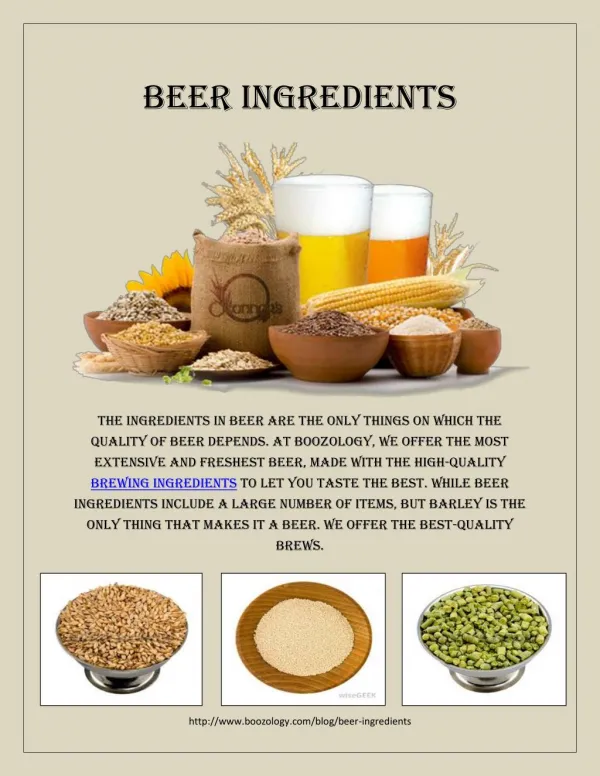
Beer Materials • Barley • Hops • Yeast • Water
Barley • Hordeum spontaneum Wild Barley • Hordeum distichon; 2 rowed barley • Hordeum vulgaris; 6 rowed barley • Monocot; Poaceae family • One of the oldest cultivated crops in the world • Superb flavor for beer
Barley • 25% of barley produced is used for alcohol • 80% beer • 14% distilled alcohol products • 6% malted food products
Hops • Humulus lupulus • Dicot; Cannabaceae family • Minor ingredient used for adding bitterness and aroma to beer • Classified as bittering added at the beginning of brewing or as aroma hops added at the end of brewing
Yeast • Fungi • Ale yeast (top fermentation) Saccharomyces cerevisiae -Ales, Porters, Stouts, and Wheat beer • Lager yeast (bottom fermentation) S. carlsbergensis -Pilsners, Bocks, and American Malt Liquors
Water • Mineral content contributes to beer flavor • Beer is 90% water • Munich-water is high in carbonates-dark beer • Dortmund-water is high in carbonates and chloride-lagers and pale ales
Typical Beer Making Process(Bottom Fermentation) • Make Wort • Brew • Fermentation • Secondary Fermentation • Natural Carbonation
Making Wort • 2 gallons hot water 160-170 degrees F • Add 12 oz. crushed grains • Steep for 20 minutes • Add 6.6 lbs. plain light malt extract
Brewing • Add 1.5 oz. bittering hops to boiling wort • Allow to boil ~ 1hour • Add 1.5 oz. aroma hops (finishing hops) • Rapidly cool wort ~ 70 degrees • Dilute wort with water to specific volume (5 gallons)
Fermentation Process • Add 1 packet yeast to cooled wort • Let solution ferment (7-10 days) while maintaining constant temperature ~ 70 degrees • Pour (siphon) beer off of yeast
Secondary Fermentation (Optional) • Let beer sit (microscopic yeast) • Pour (siphon) beer off of yeast
Natural Carbonation • Add 5 oz. of priming sugar • Put beer in container • Let sit ~2 months for full carbonation
Chemistry • Barley has a high complement of enzymes used to convert starch into simple sugars and protein for yeast nutrition. • Hops has bacteriostatic activity that inhibits the growth of gram positive bacteria in the finished beer. • Yeast convert fermentable sugars into alcohol and carbon dioxide as a by-product.
Yeast Chemistry • yeast + sugar pyruvic acid + CO2 • pyruvic acid + 2 electrons ethanol (drinking alcohol) • Alcohol is a by-product of yeast performing glycolysis in anaerobic energy conversion
U.S. Industry Facts • 2,400 Brewers & Beer Importers • 1,908 Beer Wholesalers • 551,000 Retail Establishments • 1.78 million employees (54 billion in benefits and wages) • U.S. exports to over 100 countries
United States Beer Consumption 37% of the population are regular beer consumers 25% of adults are weekly drinkers 12% of adults are monthly drinkers 14% of adults are past year drinkers 20% of adults are less than past year drinkers 29% of adults are non drinkers Anheuser-Bush Inc.
Current United States Beer Industry 3 major leaders control 80% of the market share Anheuser-Busch Miller Brewing Adolph Coors
Arkansas Establishments • 10 Brewing • 32 Wholesaling • 2,396 Retail
Arkansas Industry • Direct Impact 5,900 Jobs $102,966,194 Wages • Supplier Impact 1,268 Jobs $41,788,442 Wages • Induced Impact 10,044 Jobs $212,870,989 Wages
Advertising • Super Bowl Ad • 1997- 1.2 million for 30 seconds • 2007- 2.6 million for 30 seconds BUD LIGHT Super Bowl Commercial
Advertising • Actually doesn’t increase total consumption • Focus is on creating brand loyalty www.postdam.edu
Most common alcohol consumption problems • Alcohol poisoning -when parts of the brain shut down because of the high amount of alcohol in the blood stream • Hangovers -Dehydration-headache -Inflammation of esophagus-heartburn -Acid accumulation in stomach-nausea -Low blood glucose levels-shakes, dizziness, blurred vision & tiredness -Intestinal inhibition- diarrhea
Problems continued • Binge Drinking • Studies suggest that binge drinking rates are declining.
Problems continued • Consuming alcohol during pregnancy can cause Fetal Alcohol Spectrum Disorder (FASD) • Fetal Alcohol Syndrome (FAS) • partial Fetal Alcohol Syndrome (pFAS) • Alcohol-Related Birth Defects (ARBD) • Alcohol-Related Neurodevelopment Disorder (ARND)
Problems Continued Drinking and Driving “In 2005, 16,885 people died in alcohol-related motor vehicle crashes, accounting for 39% of all traffic-related deaths in the United States” (NHTSA 2006). “An alcohol-related motor vehicle crash kills someone every 31 minutes and nonfatally injures someone every two minutes” (NHTSA 2006). “Each year, alcohol-related crashes in the United States cost about $51 billion” (Blincoe et al. 2002).
Organizations Resulting from Alcohol Issues • MADD- Mothers against Drunk Drivers • AA-Alcoholics Anonymous
Summary • Beer has been around for a very long time. • Alcohol is a large part of out society as a whole. • Materials • Barley, Hops, Yeast, and Water • Process • Make wort, brew, ferment, secondary ferment, natural ferment • Chemistry • Yeast forms alcohol • Benefits • Jobs (brewing, advertisement, selling, delivering etc) • People enjoy drinking beer • Drawbacks • Health related problems • Irresponsibility of drinkers
Opinion Page Did anything about the presentation surprise you? After knowing ramifications of beer, is the production and consumption good or bad for us as a society?