Download
1 / 10
100 likes | 237 Vues
This piece explores the intricate relationship between soil formation, land usage, and population density on Earth. With over 197 million square miles of surface area, only 23% is exposed land, and a mere 6% is arable. As our global population reaches 7 billion, each person has access to just 1.10 acres of arable land. The dynamics of soil, shaped by climate, microorganisms, and geological factors, reflect a living system that is continually evolving. Understanding soil's role is crucial for sustainable agriculture and addressing future food security.

E N D
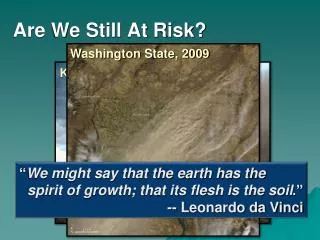
Are We Still At Risk? Washington State, 2009 Kansas City, 2004 “We might say that the earth has the spirit of growth; that its flesh is the soil.” -- Leonardo da Vinci
Space Ship Earth The Big Picture Simple Math Tells the Story: • 197 million sq. miles = Earth's surface area • 45 million sq. miles is Exposed Land (23%) • 12 million sq. miles is Arable Land (6%); that's 7.68 billion acres (1 mile = 640 acres) • 5 million sq. miles under cultivation (2.5%); that's 3.20 billion acres • 7 Billion People(7,000,000,000) • 1.10 acres of arable land for each person • 0.46 acres of land under cultivation for each person Is this your acre? Or, This?
Soil Formation • Soil formation is dynamic and affected over time by: • Climate • Topography • Parent Material • Macro- and Microorganisms “Most of all one discovers that the soil does not stay the same, but, like anything alive, is always changing and telling its own story. Soil is the substance of transformation.” -- Carol Williams DYNAMIC! A very important point in dealing with correcting soil problems!
From the Bottom Up SOIL
Topsoil A: Subsoil B: Horizons Parent Material C: Bedrock D: Soil Layers It's Like a Layer Cake Horizons Upper Mantle, Lower Mantle, Outer Core, Core, Giant Mushrooms, Dinosaurs, Arne Saknussemm, etc.
Topsoil A: Subsoil B: Parent Material C: Bedrock D: TOPSOIL: the most important horizon for plant growth
Topsoil A: Subsoil B: Parent Material C: Bedrock D: Soil Formation: Organic O: What’s Up Goes Down Desert Soil: No Organic Layer
Topsoil A: Subsoil B: Parent Material C: Bedrock D: Soil Formation: Organic O: What is Limestone? pH pH pH pH Limestone Limestone Calcium Carbonate: CaCO3 Crystalline form of Calcium Carbonate What’s Down Goes Up
Soil Formation: Aeolian (Eolian) Soil: deposited by wind Alluvial Soil: deposited by water