Download
1 / 23
230 likes | 332 Vues
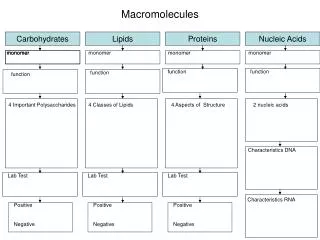
Macromolecules are large organic compounds essential for life, composed of smaller molecules called monomers. There are four major groups of macromolecules: carbohydrates, lipids, proteins, and nucleic acids. Carbohydrates are formed from monosaccharides, linking to create polysaccharides. Lipids, include triglycerides and phospholipids, serve as energy storage and membrane components. Proteins consist of amino acids that perform various functions, while nucleic acids (DNA and RNA) store and transmit genetic information. This overview encapsulates their structure and significance in biology.

E N D
Macromolecules CA Science Standards #1b, 1h
Macromolecules: • Macro = large • “A very large organic molecule (polymer) composed of many smaller molecules (monomers)” • Each large molecule has its own set of building blocks • 4 major groups (categories)
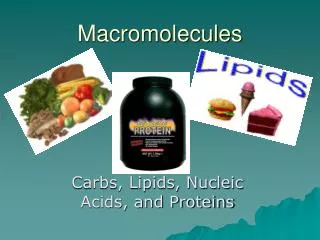
Macromolecules: Four Groups Lipids Carbohydrates Proteins Nucleic Acids
Carbohydrates Wheat Grains
Holt, Modern Biology Polysaccharides: the largest form of carbohydrate. • Composed of monosaccharides • i.e.: monosaccharides are the “building blocks”. • A few common ones:
Holt, Modern Biology How to Make a Disaccharide • Slap together 2 mono’s • “Condensation Reaction” a.k.a., • “Dehydration Synthesis” • Glucose + Glucose = Maltose (+ water) "Slap" Mono Mono Di --> +
Prentice Hall, Biology Another Disaccharide • Glucose + Fructose = Sucrose (+water) Disaccharide
How to Make a Polysaccharide • Connect MANY mono’s • Keep on condensing (or dehydrating) Cellulose Magnified a jillion times (From a plant)
Polysaccharide: Cellulose Magnified umpteen-thousand times Magnified not-so-much
(From an animal) Polysaccharides: Glycogen and Starch Starch (from plants) has essentially the same structure as glycogen.
Holt, Modern Biology How to break down a Disaccharide (or Polysaccharide) • Just add water • “Hydrolysis” reaction • Maltose (+water) = Glucose + Glucose Mono Mono Di "Rip"
Prentice Hall, Biology Another Bust-up • Sucrose (+water) = Glucose + Fructose
Three monosaccharides were bonded to produce a polysaccharide.
2. Lipids • Composed of fatty acids and glycerol
Lipids: Triglycerides • Useful for long-term storage of energy; warmth; organ protection (cushion) • What reaction took place?
Lipids: Unsaturated Fats • Too much fat = bad (heart disease) • Unsaturated better than saturated • Unsaturated –> increase HDLs over LDLs
Lipids: Phospholipids • Cell membranes, remember?
Lipids: Steroids • Many animal hormones are steroids • E.g., testosterone • Cholesterol- needed by nerve cells Steroid
3. Proteins • Composed of amino acids • i.e.: the a.a. = “building blocks” • Amino acids are joined by peptide bonds • The string of peptides is also called a polypeptide • Needed for muscles, skin, cell membranes, and enzymes peptide bond
4. Nucleic Acids • DNA or RNA • Composed of nucleotides • i.e.: nucleotide = “building block” • 5 different nucleotides (5 diff. bases-ATCGU) • Stores and transmits genetic information. Who am I?