Mastering the French Future Tense: Formation, Use, and Time Indicators
90 likes | 206 Vues
This guide covers essential aspects of the French future tense, including how to form it correctly and the various structures that can express future actions. We explore three primary ways to describe future actions in French: the immediate future (using "aller" + infinitive), the simple future tense (using infinitive + future endings), and even the present tense for future ideas. Additionally, we identify irregular verbs, providing their specific stem changes. Finally, we highlight key time indicators for expressing future events, helping you to navigate the future tense with ease.


Mastering the French Future Tense: Formation, Use, and Time Indicators
E N D
Presentation Transcript
The future tense 1- Use 2- Formation 3- Time indicators V. Passerat
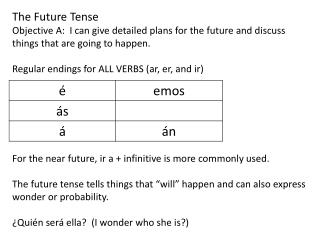
1- Use • The future tense is used to describe something that is going to happen or will / shall happen later on. • As in English, there are three main ways of describing the future action. V. Passerat
2-1- The immediate future(in English “going to” + verb) • The French structure is “aller” verb in the present tense + an infinitive (that is to say a verb ending in “ER”, “IR” or “RE”). • Je vais jouer • Tu vas jouer • Il, Elle, On va faire • Nous allons faire • Vous allez finir • Ils, Elles vont finir (…) V. Passerat
Examples au foot Je vais jouer manger une glace Tu vas Elle va du shopping faire V. Passerat
2-2- The future tense(In English, will/shall + verb) • The French structure is the infinitive form of the verb + the specific future endings. • Don’t forget to remove the “e” of “RE” verbs before you do so! • Je jouer ai • Tu jouer as • Il, Elle, On choisir a • Nous choisir ons • Vous boire ez • Ils, Elles boire ont V. Passerat
2-3- The present (!) • You may express a future idea with a present tense. • Examples: Ce week-end, je reste à la maison. L’année prochaine, je pars en Italie. V. Passerat
2-4- Irregular verbs • Here is the list of verbs that alter their stem in the future tense. Once it is altered, it stays the same at all persons. • Être ser + endings • Avoir aur + endings • Aller ir + endings • Faire fer + endings • Pouvoir pourr + endings • Savoir saur + endings • Vouloir voudr + endings • Venir viendr + endings V. Passerat
3- Time indicators Demain (tomorrow) Après (later) Ce soir (tonight) Cet après-midi (this afternoon) Ensuite (after) Plus tard (later on) Pendant les vacances(during the holidays) Le week-end prochain(Next week-end) L’année prochaine (Next year) V. Passerat