Strategies for Bully-Proofing: Embedding Practices in School-wide PBS
230 likes | 359 Vues
This guide outlines effective strategies for incorporating bully-proofing into existing School-wide Positive Behavior Support (PBS) systems. It addresses the definition of bullying, how social dynamics contribute to these behaviors, and emphasizes the importance of establishing clear behavioral expectations. The approach focuses on teaching and reinforcing appropriate behaviors, using a "stop signal," and promoting active involvement from all students in creating a safe and respectful learning environment. This research update provides insight into practical applications for educators.


Strategies for Bully-Proofing: Embedding Practices in School-wide PBS
E N D
Presentation Transcript
Embedding Bully-Proofing in School-wide PBS Scott Ross Rob Horner University of Oregon www.pbis.org
Goals • Define a set of core features for Bully Proofing • Define how to embed Bully Proofing into existing School-wide Expectations. • Provide current update from one research effort.
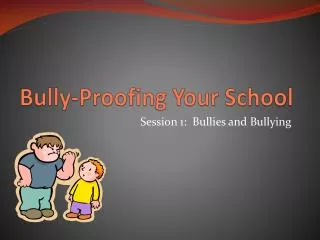
Main Ideas • “Bullying” is aggression, harassment, threats or intimidation when one person has greater status, control, power than the other. video
Main Ideas • Bullying behavior typically becomes more likely because the “victims” or “bystanders” provide rewards for bullying behaviors. • Social attention • Social recognition • Social status
Main Ideas • All “bully proofing” skills are more effective if the school has first established a set of school-wide behavioral expectations.
Creating Effective Learning Environments • Create environments that are: • Predictable • Consistent • Positive • Safe
An Approach • What does NOT work • Identifying the “bully” and excluding him/her from school • Pretending that Bullying Behavior is the “fault” of the student/family/victim. • What does work • Define, teach and reward school-wide behavior expectations. • Teach all children to identify and label inappropriate behavior. • Not respectful, not responsible., not safe • Teach all students a “stop signal” to give when they experience problem behavior. • What to do if you experience problem behavior (victim, recipient) • What to do if you see someone else in a problem situation (bystander) • Teach all students what to do if someone delivers the “stop signal”
Do not focus on “Bullying” • Focus on appropriate behavior. • What is the behavior you want • “Responsible” • “Respectful”
Teaching Social Responsibility • Teach school-wide expectations first • Be respectful • Be responsible • Be safe • Focus on “non-structured” settings • Cafeteria, Gym, Playground, Hallway, Bus Area • Teach Bully Prevention “SKILLS” • If someone directs problem behavior toward you. • If you see others receive problem behavior • If someone tells you to “stop”
Teach students to identify problem behavior. • The key is to focus on what is appropriate: • Teaching school-wide expectations, and teach that all problem behaviors are an example of NOT being appropriate. • Define most common problem behaviors. Use these behaviors as non-examples of school-wide expectations.
Teach a “stop” signal • If someone is directing problem behavior to you, or someone else, tell them to “stop.” • What is the “Stop Signal” for your school? • “Stop” • “Enough”
Teach how to use the “Stop Signal” • How do you deliver the “stop signal” if you are feeling intimidated, harassed, bullied? • How do you deliver the “stop signal” if you see someone else being harassed, teased, bullied?
Teach “walk away” • Most socially initiated problem behavior is maintained by peer attention. • Victim behavior inadvertently maintains taunt, tease, intimidate, harassment behavior. • Build social reward for “walking away” • Do not reward inappropriate behavior.
Teach “getting help” • Report problems to adults • Where is the line between tattling, and reporting? • Did you request, “stop” • Did you walk away?
Embedding Bully-Proofing: One Example • How Bully-Proofing was taught in one school • How data was recorded • Current status of research effort
How it was taught • School Rules: • Be Safe, Be Kind, Be Responsible • Problem Behaviors • Basketball, Four square, In between • Why do kids do it? • Stop, Walk, Talk
How data are recorded • When problem behavior is reported, staff follow a specific school-wide response: • Reinforce the student for reporting the problem behavior (i.e. "I'm glad you told me.") • "Did you tell the student to stop?" (If yes, praise the student for using an appropriate response) • "Did you walk away from the problem behavior?" (If yes, praise student for using appropriate response)
How data are recorded • When students report problem behavior appropriately, staff initiate to following response: • "Did ______ tell you to stop?" • If yes: "How did you respond?" Follow with step 2 • If no: Practice the 3 step response. • "Did ______ walk away?" • If yes: "How did you respond?" Follow with step 3 • If no: Practice the 3 step response. • Practice the 3 step response.
Current Status of Research Effort: • Observed 3 students recognized by the school for exhibiting problem behavior outside the classroom. • Observed recess for • Physical Aggression • Verbal Aggression • Recipient Responses • Bystander Responses
Activity • Review school-wide Expectations • Define a “stop signal” • Define how “stop signal” should be used • By individual • By witness • Define “walk away” procedure • Emphasize not rewarding bad behavior • Define rules for reporting inappropriate behavior. • What is the difference between tattling and reporting?